Hello everyone, today I come to tell you about the experience of what has been my complete return to the distribution that I have used for some years and that has always had all my respect: Debian. If you hope to read something related to the controversy of systemd, Devuan, or the resignations of some of its developers, better click on the logo of DesdeLinux and read something else. Simply and plainly I am going to tell the user experience that what will be version 8 of Debian, by name "Jessie".
For those of you who are not informed, the team Debian froze the branch testing the November 5th. From that point on, nothing new comes in and only bugs are fixed for the new release. If you want to install this version (fully prepared for when Jessie be stable you can do it from here: Jessie Installer)
So below I detail some things that, from the point of view of a mere common user, are worth mentioning about it.
Installation
The version of the installer currently in the images of Debian is beta 2, from which you can see the misprints on the same website. The main difference found, with respect to other installations, is the acceptance of the key of my Wifi network, this time being able to carry out the installation without having the laptop connected to the router.
The second difference is the possibility of choosing the desktop environment, if you need it, within the same installation. In other versions of the installer, one had to be clear about the desktop environment that one wanted to select it before starting the installation process. This is no longer the case and once the hard disk is partitioned and the base system installed, the menu will be shown with all the options that we have available to install (web server, printing system, etc.). Within "Desktop Environment" the most popular are shown. In my case, I opted for Mate instead of Xfce for having a more active development, wanting something moderately light and for being deep down a user who misses Gnome 2.
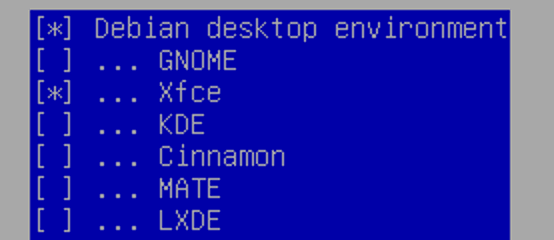
Image taken from: https://blog.sleeplessbeastie.eu/2014/10/17/debian-jessie-and-a-little-change-during-installation-process/
We see a simpler installer avoiding possible errors for new users who are not used to Debian.
After install
Necessary mention for users of Mate is the default installation that does Debian. By default, just install the package mate-desktop-environment that installs the fully functional environment, similar in appearance to how it comes by default Mate.

However we can open a terminal and install:
sudo apt install mate-desktop-environment-extras
what installs some utilities as the option "Open terminal here" in Box, something that I personally find very useful.
Another thing that we could point to as "complicated" is the installation of printers. Mate it does not bring any utility to manage printers (or at least I have not seen it on my system). But CUPS, the incredible printing system, is installed by default. So I set up a printer HP without any problem following the steps of the wiki of Debian. Basically you must enter from your browser of preference in the path: http: // localhost: 631. The interface of CUPS allows for quick setup that anyone can do.
Once this is done, we can now install the packages that we like the most. I am not going to go into the installation of applications, because I think that it is something very subjective and it is impossible to satisfy everyone's taste. I'll just say that I can currently live without Flash (since it doesn't install it by default) and it's a joy to navigate without it.
System performance
Once installed and with the default configuration (a trip back in time for lovers of Gnome 2), the system starts up with some great 250-300 Mb of RAM, which represents a percentage of 6.75%-8.1% on my system (3.7 Gb). Quite well within the typical consumption of a standard distribution.

In previous installations of Debian, I had noticed that the sound was not set properly. It did not adjust the volumes correctly, the sound could not be recovered if the volume was turned down, etc. However, I do not know if due to Mate, to the new kernel or what, this problem no longer occurs in my system. The volume is remembering between that of the headphones and that of the speakers independently. Perfect in this regard.
The system perfectly manages hybrid graphics (turning off the ATI) And the sound. As well as the fans of the graphics, etc. So I can say, that the team of Debian he has done considerable work.
Using Mate on Debian
Regarding the daily use of Mate, version 1.8.1, saying that while it still has some way to go and bugs to fix, it provides a very good user experience for those of us who liked Gnome 2. But let's not just stop there, because today is much more. The development of Mate it is made with users in mind, on a traditional, self-contained desktop. We still stand in gtk2, although it is planned to move to gtk3 in version 1.12. If we look at the The roadmap, we find support for Wayland also in version 1.12.
On a day-to-day basis, your applications perform great. Special mention for Lectern (viewer of PDF) that handles files of more than 100 sheets in a very fluid way, something that did not happen with Evince en Xubuntu o Linux Mint with Cinnamon. On the other hand, the rest of Mate's own applications work correctly since they come from the equivalents in Gnome 2 and improved by the development team of Mate.
On the whole, I think the environment feels light and whole. Mate it is a desk that does what it has to do without frills or excesses. As a picture is worth a thousand words, I leave you with an image of how it can be beautiful.

Conclusions
Finally, it should be said that this version of Debian promises to be great for pedestrian users. We have Mate 1.8.1, KDE 4.14.X, Gnome Shell 3.14.2, Xfce 4.10 y Cinnamon 2.2. That is to say, quite recent desktops and in very mature versions.
Improvements in Debian are greatly appreciated. In general, they bring large distribution, which is Debian, mother of many others. From here, I encourage you to try version 8 when it becomes stable, because I think it will not disappoint anyone. If someone is very impatient, they can try it now even if it has the label of testing. I have always used this branch and have never had any problems. Guaranteed stability.
While it is true that we are talking about Debian, this is applicable to the entire ecosystem. The improvements come at their own pace, but they come and they do it very well. Improvements in the kernel, stability in graphics environments, applications, etc. Usually GNU / Linux it is progressing at a good pace and we must congratulate all the people who make it possible.
Without anything else to add, I hope this writing has served you.
So good, thanks for sharing. 😉
It's great to see the progress Debian makes over time.
The truth is that it has improved a lot at the user level. Just yesterday I installed a Debian Jessie + KDE companion and it is also very good for home users.
All the best
Very good review; in Debian desktop environments generally perform better because they are more optimized. The same goes for Arch, Gentoo, Slackware or another distro looking for simplicity.
"We are still in GTK 2, although it is planned to move to GTK 3 in version 1.12"
Actually GTK3 support will be added, the main MATE developer commented in an interview that he does not intend to leave GTK2, it will have the two together even if it is a spaghetti - I don't like this too much.
Greetings.
Thanks for the clarification. I thought they were going to migrate the environment to GTK3. Well, we'll see how it evolves. At the moment version 1.8.1 of Debian 8 is very good and usable.
All the best
Very good.
I have been using Debian testing kde for some time now. It runs very well, only it has some problems (bugs) with some programs like amarok, clementine, java. But I see that they are being corrected.
A while before, I was doing a comparison of which distro I am going to install. The competitors were: openSUSE, Arch, Gentoo or Slackware. Of all, Debian has an advantage in several areas such as: Number of packages, stability, support, "a rolling version (testing)", etc ...
The only thing that Debian fails me is the integration of gtk2 / gtk3 with qt packages in Xfce. And I even tried with qt4-qtconfig or similar ones and I can't change the horrendous themes that it installs in the qt programs.
This was my desktop before:
http://k41.kn3.net/taringa/7/3/3/4/2/0//kik1n/5DD.jpg?8436
http://k34.kn3.net/taringa/7/3/3/4/2/0//kik1n/473.jpg?741
Yes, if that is corrected, at this moment I return to Debian xfce 😀
regards
Friend, pass me your conky because I loved it !! XD
http://www.mediafire.com/download/oi5560fbqgeoifo/Conky0001.tar.gz
regards
It also happens to me in Mate with VLC. It must be some missing package. I will investigate it today to see if I get something clear and put it here.
A greeting!
Sorry, I think it's installing libgnomeui.
It is clear how to fix it:
sudo apt-get install qt4-qtconfig
Then you open the program, for example from the terminal: qtconfig, or from Preferences. You will see that there is a section that says GUI Style that is in: Desktop settings. You just have to change it to: GTK +
Then File -> Save.
This fixes the appearance of the Qt applications.
KDE? How did you go about setting the title to the applications menu? I tried I could.
Ah no, nothing to see, it was XFCE 🙁
xD
ahh there is going to be a discussion about systemd so I am not interested !!!!!! XDDDD
Very good article, I did not know about the intentions of porting Mate to gtk3, I also don't know if such a change is so necessary. for me the real problem is that gnome brings many more programs than mate or lxde or xfce, such as a video player, an email, a cd recorder, etc, etc. And it can't be that if I sing about installing totem or evolutiom, it asks me to install half gnome, that is, if I'm installing mate or xfce or lxde it is because I don't want to use gnome (the same for kde programs.)
I think debian folks should try harder and check the dependencies issue.
I guess every environment sweeps for your home. They want you to use their software for the whole "user experience" thing. Nor does it seem wrong to me that they try to do so. If you don't want to use some software, just install another and use the latter.
I'm a bit of a maniac with that but hey, how can you do it, hahaha.
Excellent! Thanks for sharing
Thanks to you for reading it!
A greeting!
hello.
To go from stable to testing is it so easy to change in the source.list what wheezy says to jessie / stable to testing, or do you have to do something else? What a good tutorial to do this they recommend.
In principle you should point the repositories to testing or jessie. But I always recommend doing a clean installation of the branch you want, since these experiments usually bring a problem.
Anyway, if on your own responsibility you want to do it, after pointing the repositories to jessie / testing simply: apt-get update && apt-get X, where X can be: safe-upgrade, dist-upgrade, upgrade, full- upgrade, depending on the degree of update you want.
Although, for my part, I recommend you wait for version 8 to be stable or, if you are very impatient, reinstall with the test iso.
A greeting!
It is being incredible, I hope that in future versions they will integrate the option for PPAs with that it would be very easy to have our favorite latest software without sacrificing stability
currently debian backports exists but it is not as versatile as PPAs
I don't think they integrate something like a PPA, as Debian doesn't specifically target normal users like Ubuntu or Linux Mint do. I also think that, in general, PPAs are abused a lot and the need for the latest versions of the programs. It's okay to not have the latest as long as things are going well for you. I have friends who use Debian 7 that came out 2 years ago and it suits them perfectly for their day to day.
A greeting!
Something that I miss in Mate vs Xfce or Cinnamon are the real transparencies. That is, if you open a terminal with transparency in XFCE or Cinnamon, you can really see what's underneath, a window or the desktop with its icons. In Mate you only see the image set as the desktop background, even if you have windows or icons below the terminal with transparency it will not be seen. Maybe to some it will seem like bullshit but it is very practical to type in the upper window something that you have in another window without adding more space or having to adapt windows. Using terminals like Guake, Tilda, or similar is a real drag.
Inside mate-desktop you can install xfce4-terminal.
It is not the terminals themselves, it is more about how the graphic environment manages the transparencies. Even so I have installed and tested it so as not to give up your advice, as I imagined it does the same effect. Maybe there is some Compiz feature that enhances this feature and enables this, has anyone come across this?
Greetings,
David.
Do you use the mate configuration with leftovers ??????, I think in gnome 2 what you say happened when you had leftovers activated
I'll just say that, currently, I can live without Flash (since it doesn't install it by default) and it's a joy to navigate without it.
If you keep saying the same thing the day you want to watch a video on Pornhub, Xvideos or Redtube without using Flash.
I don't know if it's irony or not. But I think that:
1. Watching porn doesn't seem like a strong reason to use flash.
2. Not everyone likes porn.
3. Assuming you like it and can't live without it, you can always download it and watch it quietly on your VLC, totem, Parole, etc.
Like everything, it is a matter of priorities. However, it seems to me that since Adobe, as far as I understand, no longer makes Flash for Linux, users should start not to use it.
All the best
1. For me it is a compelling reason, because unlike YouTube, so far there are no relevant porn video sites that work completely in HTML5, but there you.
2. Only asexuals and eunuchs don't like it. Won't you be one of those?
3. It is a plug, I am not saying it because of extracting the link to download the file (which in the sites I frequent can be obtained very easily, but there are others where it is well hidden, encoded and / or it is a streaming that happens because of that RTMP mess) but because I don't want to fill my hard drive with porn (I already have enough for when I lose the internet for a long time, thanks but no thanks).
4. In this I give you the reason, I just confirmed the end of support for Flash in Linux, it seems that the only thing that can be done so far is:
* Use the Chrome plugin in Firefox. I guess it's the most practical solution, but I don't feel like having Chrome installed just because of that filthy Pepper. If instead a package comes out to install the plugin independently, I can reconsider.
* Try your luck with Gnash or lights park (Does anyone know how they perform on those sites?) Although Gnash seems to be dead (last update: February 15, 2012).
* Wait for Mozilla to have a stable and functional version of Shumway (Maybe in another 5 or 10 years because the only thing it currently supports are some animations and basic things).
* Apparently, several of these sites use HTML5 in their mobile versions so it should be enough to change the useragent (I prefer to leave this as a last resort since mobile versions of them always seemed very limited to me).
As you imagine, I will stay with the Adoba Flash until I say enough or there are alternatives that are up to the task (whichever happens first) although the ideal would be a player in which you pass a link to any video site and that play automatically (if possible, let you also select the quality).
I do not know when you have taken my opinions as arguments in a debate that I have never intended to start. I express a personal reality and nothing else. Step to continue with this conversation since it does not contribute anything to the post. In my system I will install whatever I want, as you install whatever you want on yours. However, I think that phrases / innuendo like:
2. Only asexuals and eunuchs don't like it. Won't you be one of those?
they are totally out of place. It does not seem correct to me to judge people you do not know, much less for a nonsense like consuming porn.
A greeting! 😉
Very good, for small screens I recommend installing mate-netbook, an applet for the panel that hides the title bar of the applications and allows you to save space.
I installed mate on an eeepc701 with 512 ram and it works fine
I did not know this applet. It can also be interesting for large screens where a little more space is required.
Thanks for sharing!
Some reviews ... because I've been using debian continuously for a long time ...
The problem you had with the sound was probably due to installing pulseaudio. See if you have it installed now, hopefully not.
The consumption of TU mate-desktop is very high ... I don't know why, but a clean installation of mate does not usually exceed 160 or 180 mb. in debian. I use xfce and it is around 130 mb boot (maybe you took it after installing some software).
All hp printer users have the hplip and hplip-gui packages available in the repos. Just by installing it, you don't even have to use the browser. Although the method you mention is correct, it is even easier to install this package.
Totally agree with the lectern, the one I use in xfce .. evince has a gtk3 face and xpdfview must be without support because it is so slow (I miss the wonder of okular).
Something to recommend is mupdf.
I recommend that you use sid without fear, which turns out to be very stable, but nobody recommends it because it is not in fashion like kaos, manjaro or antegros. (the mainstream, god save me and keep me)
greetings from the south.
Good morning!
Thank you very much for the advice.
1. As for pulseaudio, I do have it installed. So it must be something else. Maybe some improvement in Debian's default configuration or maybe something related to hybrid graphics and audio output channels. The point is that it has miraculously been solved and now it is going perfectly.
2. Consumption is after installing all the software I use. It might be high because of that. The image was captured after installing mate-extras, so it can affect that too.
3. I had no idea about hplip, hahaha. Very good advice. Still, I took the opportunity to touch CUPS a little, which is very good software and rarely does it justice.
4. In my case, evince doesn't throw away anything with large files like books or manuals. Lectern is just perfect. I'll take a look at mupdf anyway.
5. About using sid, I have thought about it many times, but every time I am more stable in the sense that I seek to have something functional and that never fails. In fact, when Jessie becomes stable, I don't think I will move to testing. I'll leave it with Jessie until I can.
Greetings and, once again, thank you very much for the advice!
That debian testing is stability guarantees it will not be ...
Any experience to share? Or is it just a free affirmation?
A greeting!
Well, serious problems with the management of the distro's package after an update, that is, shortly after the new version comes out, which is when I test in more unstable.
Typical of this type of distro like the rolling ones ……
I do not agree. Yes, a rolling Release effect can break the system, but in Debian Testing, it is the most stable I have ever seen. And not only that, it configures itself, I mean, I don't have to dig into each update. Nor have I gotten to have serious problems with applications, if one or another bug, but they are small.
Let's see, perhaps it is the most stable thing you have ever had but I do not agree with the phrase that the author puts "guaranteed stability" because it is not like that. Testing like other rolling can also fail in some update and it is what this type of distros has, there is no more.
I say this because it happened to me, in fact when jessie was released, debian users recommended me to stay in wheezy for at least 2 or 3 months before making the leap to jessie for stability issues, I wanted to try it for myself and a month and a half I made the jump to testing and after 3 or 4 updates voila serious failure with the administration of the package that cannot be solved. They told me that the first months in testing there are many entries of new updates and that leads to errors and indeed it is. It is not something that only happens to me, if several recommended it to me it will be for something and I checked it myself.
After several months released, maybe the errors when updating are reduced more I do not know why I left it, I do not have much faith in rolling distros although testing is not a pure and hard rolling but it also fails.
I prefer to work on a somewhat more stable basis, opensuse or an lts are better options for me.
Weird, because I've been in wheeze (testing) and switch to Jessie (testing) (I mean, in debian, I've always been in testing). And do not get to have stability problems.
I understand what you mean. I was an openSUSE tumbleweed fanboy and one day my system died. But try to go back to Debian testing, for now, and to my liking, it's the most stable next to kde.
Now it is because it is frozen but at the time it failed me as I said and that is why I do not trust rolling distros or similar.
Excellent post, the curiosity bug entered me. I haven't used Mama for a long time and I went with one of her daughters xD, but now I'll give her fire 😀
Thanks and Regards.
I like Debian, but I feel that Debian Wheezy has been better than what is carried in Jessie, the truth is that the development of Wheezy was very long, however when I installed Jessy several times with Gnome 3 it would freeze and thundered. So I'm still on Wheezy, I hope it has many more improvements Jessie so I can use it without problem.
Hi, I just installed debian jessie on my notebook and when I want to install the printer from Settings> Printers, I find a sign that says: "The printing system service seems to be unavailable" and I have turned off the "+" to add a printer, try to install it from CUPS but when opening the browser and going to http://localhost:631/printers Mozilla tells me it can't connect !! I tried to install CUPS by console, thinking that it would not be installed and it throws me a dependency error that aptitude cannot solve, any advice? any suggestions? On the other hand I also wanted to comment on the change in GDEBI in Jessie, I have been using wheezy for almost 1 year with problems but very satisfied with its performance and stability, but when I installed a .deb it gave me the possibility to follow the installation from a console ( within the graphical environment) now if everything goes well, install without problems but if there is any conflict it throws a sign that says: «An unexpected error has occurred in the transaction, Do you have more information in the detailed report ???? Where the hell is the detailed report? Someone to guide me will be welcome !! Thanks in advance, Greetings from Argentina, Cordoba