

The release of the new version of the Flowblade 2.8 multi-track non-linear video editing system was recently announced , which allows you to compose movies and videos from a set of separate videos, sound files and images.
The editor provides tools for precisely trimming clips into individual frames , processing them with filters, and multi-level image compositing for embedding in video. The order in which the tools are used can be arbitrarily defined, and the timeline behavior can be adjusted.
The project code is written in Python and distributed under the GPLv3 license. The pre-compiled binaries are prepared in deb format . Additionally, the MLT framework is used for video editing, and the FFmpeg library is used to process various video, sound, and image formats.
The interface is built with PyGTK , while the NumPy library is used for mathematical calculations, PIL is used for image processing, and it is possible to use plug-ins with the Frei0r collection's video effects implementation, as well as LADSPA sound plug-ins and G'MIC image filters.
Its main features include :
- 11 editing tools, 9 of which are included in the basic working set
- 4 methods to insert, replace, and attach clips in a timeline
- Ability to place clips on the timeline in drag and drop mode
- Ability to attach clips and image comps to other master clips
- Possibility of simultaneous work with 9 combined video and sound tracks
- Means for adjusting colors and changing sound parameters
- Support for combining and mixing images and sound
- 10 composition modes. Keyframe animation tools to blend, scale, move and rotate the original video
- 19 blend modes to insert images into a video
- Over 40 Image Replacement Patterns
- More than 50 filters for images that allow you to adjust colors, apply effects, blur, manipulate transparency, freeze the frame, create the illusion of movement, etc.
- Over 30 sound filters, including keyframe mixing, echo addition, reverb, and sound distortion
- Support for all popular video and audio formats supported by MLT and FFmpeg. Support for images in JPEG, PNG, TGA and TIFF, as well as vector graphics in SVG format.
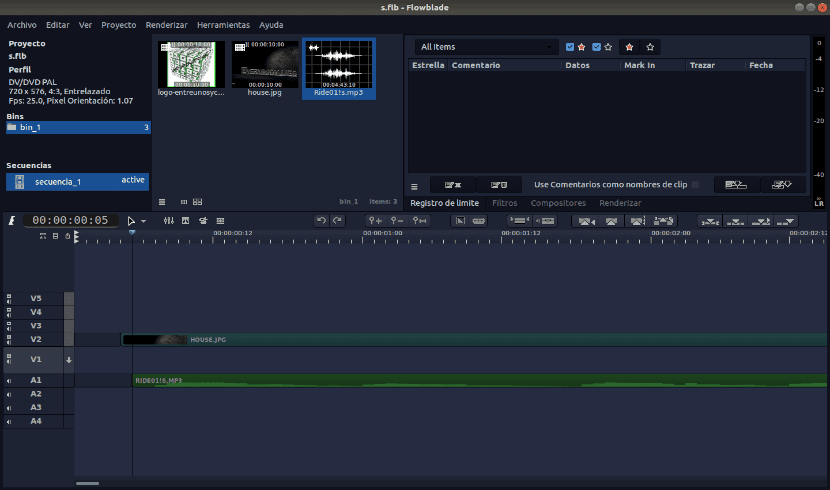
Main new features of Flowblade 2.8
In this new edition of Flowblade 2.8, the "View-> Panel Location" submenu was added to select the panel location position on screens with a resolution of 1680×1050 and higher.
In addition, two new dark themes have been introduced: Flowblade Neutral with a neutral background and Flowblade Grey with a slight blue tint. Previously, the default theme was called Flowblade Blue.
Furthermore, we can find that the ability to change the order of the elements in the central panel was provided, enabled through the menu "View->Center bar layout->Free bar" and "View->Center bar layout->Configure free bar".
Other notable changes in the new version include:
- Updated filter panel.
- The filter editing panels are now stacked.
- The filter selection panel has been moved to the right side of the timeline and allows the user to add filters by double-clicking a filter item or dragging filters onto a clip with the mouse.
- Added support for changing hotkeys.
- Added a Tool Dock widget to select editing tools along the timeline, which can be used in place of the center panel drop-down menu.
- An additional set of colored icons is provided for the center panel.
- Updated translations
How to install Flowblade on Ubuntu and derivatives?
For those interested in installing this new version, simply download it . To do so, open a terminal and type the following command:
wget https://github.com/jliljebl/flowblade/releases/download/v2.8/flowblade-2.8.0-1_all.deb
And then we install with:
sudo apt install ./flowblade-2.8.0-1_all.deb
Table of Contents