
Well, we are getting closer, I prefer to write these small posts quickly so that they do not bother me for not writing the guide at this moment: p, but you must understand that there is so much to explain in Gentoo that leaving the script would not do me much good if later they can't control all that power.
ISO images:
We all know ISO images (well all of us who have faced a Linux installation at least). Those small (or no longer as small as the case of Ubuntu) tablets that store the entire base system and replicate it on another machine.
The Gentoo ISO:
The Gentoo ISO is quite small (270 MB in console mode, 2 GB in Live mode). But if you take a look at the official download page, the first thing you'll notice is that both the minimal and live versions are updated infrequently, at least compared to Stage 3 (which we'll discuss later).

Necessary?
To be 100% honest with you, no, you don't need to download the Gentoo ISO to install it. What's more, those who have already tried it will say, many times the ISO comes with quite a few limitations (for example the support for UEFI, the minimal ISO does not have UEFI support). Also, it's just a console (someone who does 95% of their activities per console tells you) and there are better (at least easier) ways to do a full Gentoo installation.
As yo I make:
Well, here's my secret: partitions… Partitions? I'm sure you're wondering right now. Yes, partitions. Ever since my Arch days, I've always been fond of MBR. I used this label for my first Arch installation, and since I've never needed a huge number of partitions or dual-booted with Windows, I haven't felt the need to build my system on UEFI.
What I have right now on my computer is a set of 5 partitions, as I am lazy to write all of them, here I am sending you a picture of my disk.
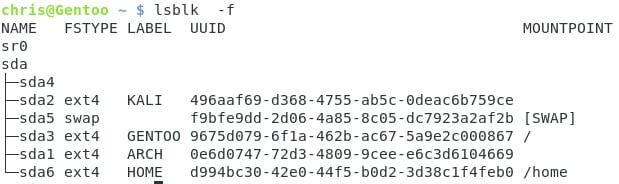
Own. Christopher Diaz Riveros
(By the way, I have always liked to show what I use, I prefer not only to talk about theory, but to show what works for me, this may not suit everyone but if I can help with those particular cases, let me know )
As you can see, I have 6 partitions inside my hard drive, using MBR I can have 3 primary ones, and thanks to the extended one I can add some SWAP to my machine. Also I have separated my /home directory so that in case of emergency, my information is not lost along with the system. This is quite useful when out of the blue your computer stops working, you can just install from scratch and mount your home at the end, piece of cake
As you can see, like any good security fanatic, I also have my Kali Linux installed, and an always useful Arch linux. Now I tell you how I use these.
Arch as a means of rescue:
As you can guess from the title, my Arch is my emergency rescue USB, whenever something happens with Gentoo that I can't fix from within Gentoo, I go into Arch, mount the Gentoo hard drive and start fixing stuff. Also, I really like a game called Bombsquad that is available on the AUR I play it with my family or girlfriend and friends whenever I can. By the way, just to be clear, Arch also has GNOME in case you're wondering if I left it on console
Since Gentoo doesn't need any installation media of its own, you can choose to install it from anywhere, Arch, Ubuntu, CentOs, etc etc… great, isn't it?
The magic is on stage3
Stage3 is a compressed file containing the entire Linux tree necessary to install a system. Thanks to this file , we can install directly from another operating system. The only requirement for using it correctly is that the mount point is empty at the time of installation, and remember that this will be our root directory for the next Gentoo system we build. To give you a rough idea of how much disk space my machine uses, here's the amount of disk space:

Own. Christopher Diaz Riveros
As you can see, 50 Gb is more than enough, in fact it's a bit exaggerated I would say, and of these 50 I use 8 Gb, including heavy programs like Virtualbox, Google-chrome (obviously it had to be available in the distribution that helped Chromebooks to be born ) and well, my GNOME suite and some other programs, but let's not stray from the topic...
Once stage3 is unzipped , all that's left is to start making tweaks, but we'll leave that for the official guide
In summary:
Well, I've already told you a little bit more about how to install Gentoo, its versatility allows it to be installed from different distros (something that I think very few can say) and at the same time allows for a small workspace. Right now I'm thinking about writing one last post before starting the guide. At the good pace I'm going these days, I hope the guide will be available very soon I'm just making sure there are no loose ends before starting. Greetings,
PS: To see other posts, you better search for more from the author because otherwise I'll be flooded with links