
I was seeing an article yesterday in OMGUbuntu about a beautiful GTK theme called Arc, which has transparency effects and a design similar to what we can find in OS X Yosemite.
Next I will show you how to install it, in my case, using a virtual machine with Antergos and of course, GNOME. In theory it is compatible with other GTK Desktop Environments, so it should work on ElementaryOS, for example.
Let's see the final result which will be:
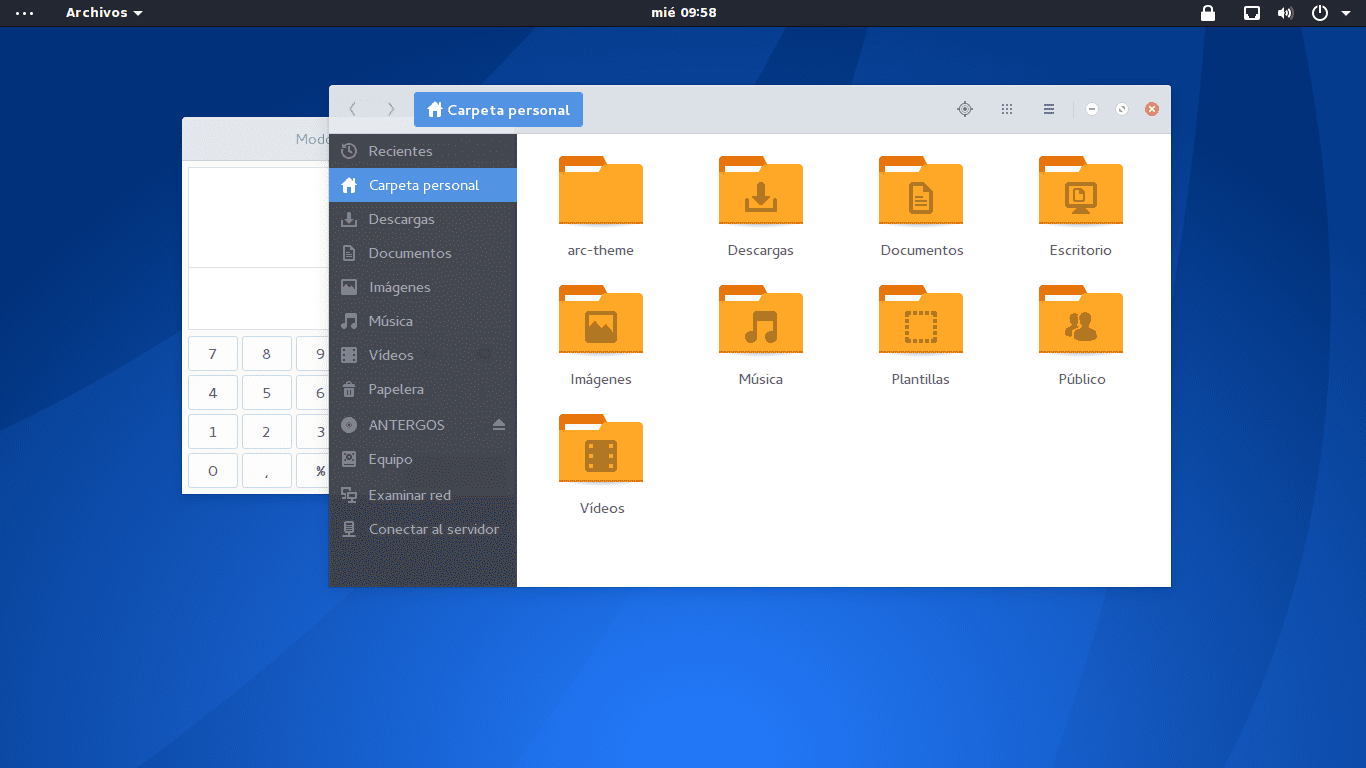
If you look, behind the Files / Nautilus side panel or whatever you want to call it, you see the calculator buttons, just like on the back of the toolbar.
Arc installation
In the case of Antergos, if we follow the steps of Arc creator, we don't have to do much, since all the necessary dependencies are installed. If they use another distribution like Ubuntu or Debian, they must have the following packages installed:
- Gnome / GTK 3.14 or 3.16
- The package gtk2-engines-pixbuf if we use Debian / Ubuntu and derivatives.
- The Murrine engine, which can change its name depending on the distribution:
- gtk-engine-murrine (Arch Linux)
- gtk2-engines-murrine (Debian, Ubuntu, elementary OS)
- gtk-murrine-engine (Fedora)
- gtk2-engine-murrine (openSUSE)
- gtk-engines-murrine (Gentoo)
In addition, we must install the following packages:
- autoconf
- auto make
- pkg-config o pkgconfig if using Fedora
- libgtk-3-dev on Debian-based distributions or gtk3-devel for RPM distros.
- git
Having this installed, we open a terminal and execute:
git clone https://github.com/horst3180/arc-theme --depth 1 && cd arc-theme
And once it's done:
./autogen.sh --prefix = / usr sudo make install
And that's it. If all went well, we can choose the new GTK theme (and the theme for GNOME SHELL), using gnome-tweak-tools.

And that's it.
Extras
The author also provides us within the Extra folder of his repository on Github an extension for the Google Chrome theme, and tells us that if we have problems in Unity with the scroll bars, let's run in the console:
gsettings set com.canonical.desktop.interface scrollbar-mode normal
And of course, if we want to uninstall it, we just have to execute:
sudo make uninstall
inside the folder where we compile the theme or
sudo rm -rf / usr / share / themes / Arc
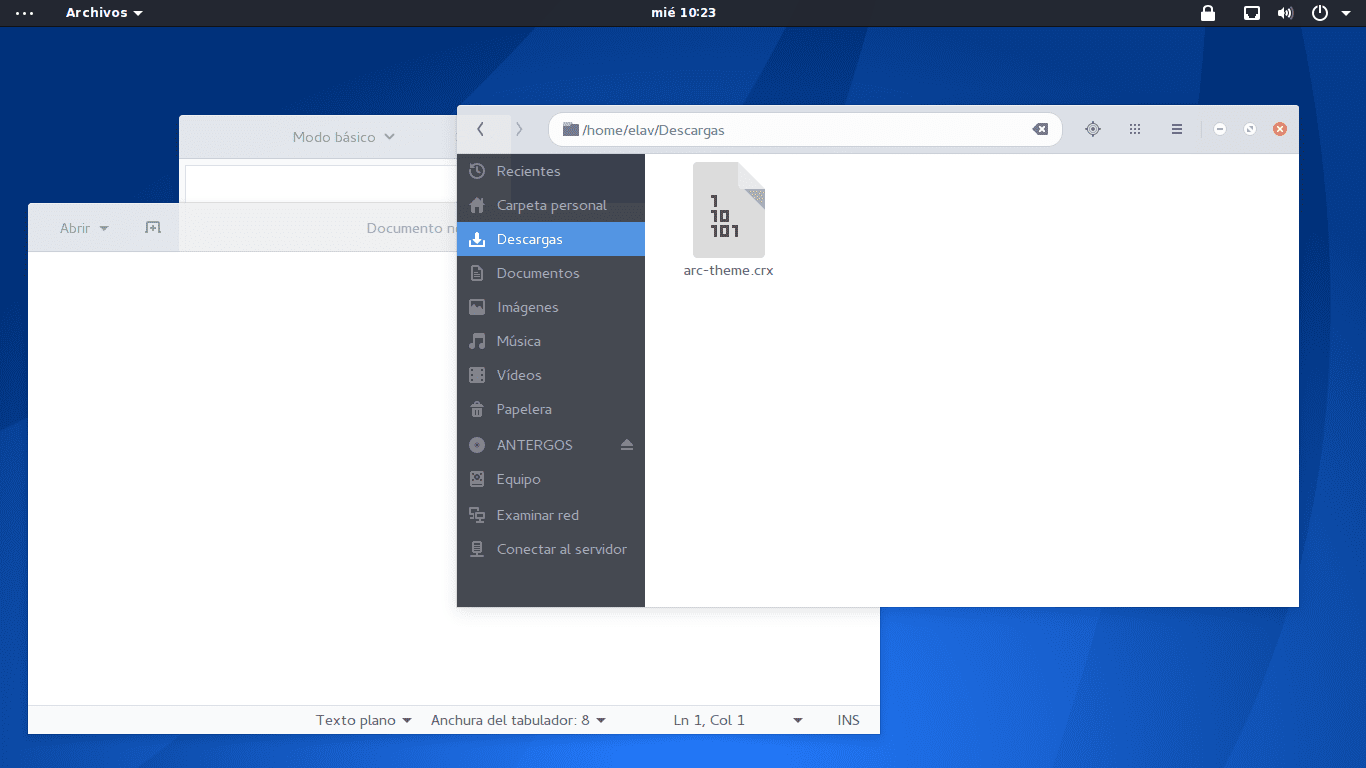
And to finish another capture:
Thanks a lot. I'll try it ...
It also works for XFCE, it has a theme for xfmw4
xfwm4, I meant.
My hands are full of fingers and sometimes they go to his ball.
How did you install it in xfce? it sends me gnome version errors
@Ellebekey
I installed it in my Antergos XFCE 4.12 as it says in the article and in its git space, no problem
A catch http://wstaw.org/m/2015/06/03/arc.png
One more sample that GTK can be as beautiful as QT without consuming so much RAM, the only thing GNOME urgently needs is a design group to change its somewhat crude default personality.
In xfce 4.12 with border it was not very nice
Any screenshot to share?
@ever
Here in my Antergos XFCE 4.12 http://wstaw.org/m/2015/06/03/arc.png
Thanks @Yoyo.
looks great!
Greetings Elav, I would like you to do a tutorial on how to install "gnome builder", when you have time.
The folders have the same appearance as the numix theme that I have installed now, very beautiful, very elegant, the difference is mine is not transparent.
Someday I will try it 😀
They are the same theme (Numix) that by default comes in Antergos ..
I would like a retro theme, minimalist themes are counterintuitive to me. But it is my personal opinion of course!
It is appreciated, as soon as I can I try it in Fedora.
My top bar, the gnome bar, is completely black and not gray, do you know what this could be? I use anteriors too.
Very nice, thank you elav.
You're welcome, by the way, thanks to you I discovered Koding .. it's great 😀
Will it be used for Elementary OS Freya ?? in case someone has tried it
I hardly comment, but the truth is that the theme installed on my fedora 22 looks great, thanks for the article.
Greetings.
How about yoyo, does it work on Cinnamon?
An apology, I asked Yoyo but that's not his blog hahahaha ..
On Arch Linux it can also be installed from AUR.
If you use packer as in my case:
#packer -S arc-theme-git
If you use yaourt:
#yaourt -S arc-theme-git
In Antergos and Manjaro the same.
Very nice, although very clear xD
Already, I uploaded it to my overlay for Gentoo 😀
I am on Ubuntu 14.04.2. It tells me that the Gnome version is not valid. Do I have to mount another quilombo to install gnome 3.14 or 3.16?
Thanks in advance for the answer… xD
Will there be something similar for KDE ??
Very good theme, I already have it working on my fedora 22 gnome shell.
Greetings.
Thank you!!! I installed it in OpenSuse and it looks great.
Very cool, thanks
I have installed it for about a month now in my open suse with gnome and the emerald icon theme and the truth is that it turned out very well, they would envy me to see it.
In Solydxk this theme comes by default, besides being a very good distro, based on Debian 8 .. 🙂
Beautiful! Does anyone know what icons are used in the capture?
https://camo.githubusercontent.com/f4ddb37192da04aa6caf1dee41341fded5714038/687474703a2f2f692e696d6775722e636f6d2f42316f726f79482e6a7067
good, I have a little problem, after I run
./autogen.sh –prefix = / usr
in the end I get this
autoreconf: Entering directory
.'. 'autoreconf: configure.ac: not using Gettext
autoreconf: running: aclocal --force -I m4
autoreconf: configure.ac: tracing
autoreconf: configure.ac: creating directory build-aux
autoreconf: configure.ac: not using Libtool
autoreconf: running: /usr/bin/autoconf --force
autoreconf: configure.ac: not using Autoheader
autoreconf: running: automake --add-missing --copy --force-missing
configure.ac:12: installing 'build-aux/install-sh'
configure.ac:12: installing 'build-aux/missing'
autoreconf: Leaving directory
checking for a BSD-compatible install… / usr / bin / install -c
checking whether build environment is sane… yes
checking for a thread-safe mkdir -p… / bin / mkdir -p
checking for gawk ... no
checking for mawk… mawk
checking whether make sets $ (MAKE)… yes
checking whether make supports nested variables… yes
checking for pkg-config… / usr / bin / pkg-config
checking pkg-config is at least version 0.9.0… yes
configure: error: invalid GNOME version: 3.10
and when i run
sudo make install
throw me this error
make: *** There is no rule for constructing the "install" target. High.
I use ubuntu mate 14.04 I hope you can help me 🙂 greetings to all.
Very nice this design, I like it because it is quite minimalist. Do you know if it can be installed on Kubuntu, or if there will be an alternative with a similar design?
Thanks for sharing. Greetings.
Everything perfect except the top bar, does anyone know what I should do to change it? xP
I managed to install it in Ubuntu Gnome but how do I install the icons so that it looks the same, ... it only shows me to close the window but not to minimize and maximize ...
http://i.imgur.com/giP30Ym.png
it looks like windows 10>. <= P
Thanks for this theme, I have installed it without any problem. Thanks a lot.
The theme is very good
but I want to know how I can get back to the topic of my system
i have ubuntu 16.04