
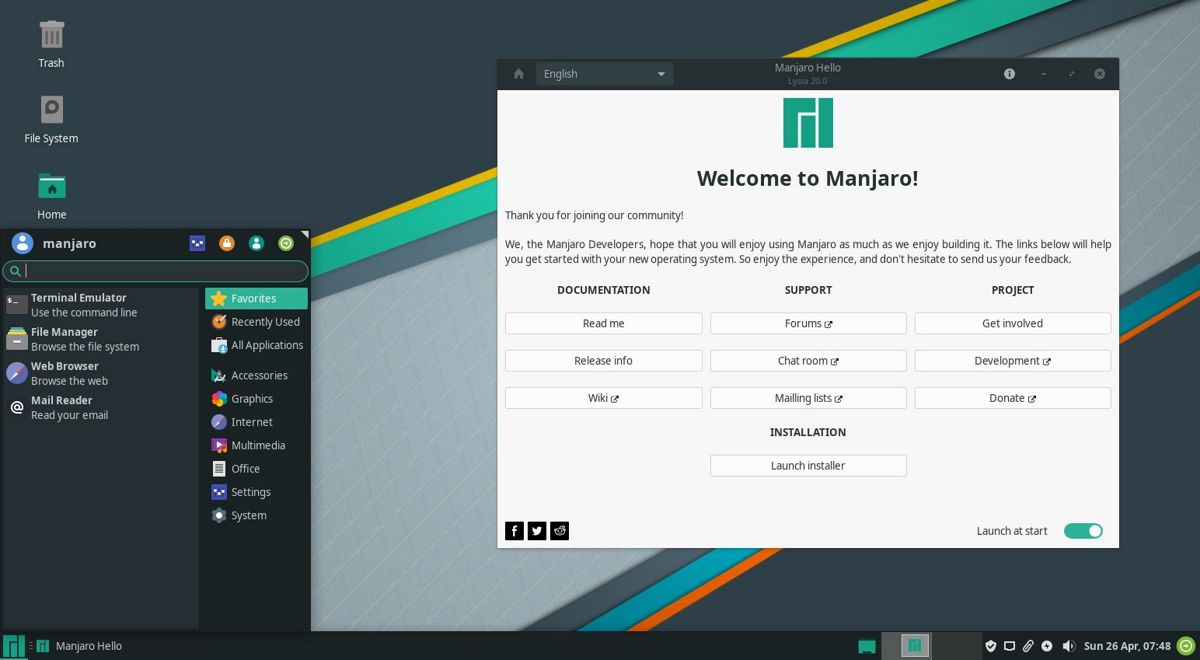

The new version of Manjaro Linux 20.0 has been released and its main feature is the updates to the different desktop environments with which the distribution is offered, in addition to the update of the different system components.
For those unfamiliar with Manjaro Linux, it's a distribution built on the Arch Linux base and geared towards novice users . The distribution stands out for its simplified and user-friendly installation process, support for automatic device detection, and installation of the necessary drivers for its operation.
Manjaro uses its own BoxIt toolkit , designed in the image of Git, to manage repositories.
The repository remains under the principle of continuous updates, but new versions go through an additional stabilization stage. In addition to its own repository, there is support for using the AUR (Arch User Repository) repository. The distribution is equipped with a graphical installer and a graphical interface to configure the system.
What's new in Manjaro Linux 20.0?
In the new version, a lot of attention was paid to updating the different desktop environments with which the distribution is offered.
This is the case with the Manjaro XFCE version, which saw improved usability with XFCE 4.14 , considered the flagship version of the distribution and featuring a new "Matcha" design theme. Among the new features is the addition of "Display Profiles," which allows you to save one or more profiles with your display settings. These profiles can be automatically activated when certain displays are connected.
For the Manjaro KDE version, a new version of the Plasma 5.18 desktop is proposed along with KDE Applications updated to the new April update, and the design is completely redesigned.
The package includes a complete set of Breath2 themes , including light and dark versions, an animated screensaver, Konsole profiles, and Yakuake skins. Instead of the traditional Kickoff-Launcher menu, the Plasma-Simplemenu package is offered.
In the case of the Manjaro GNOME version , the environment was updated to GNOME 3.36 , and the interfaces for logging in, locking the screen, and switching desktop modes (between Manjaro, Vanilla GNOME, Mate/GNOME2, Windows, macOS, and Unity/Ubuntu themes) were improved. A new application for managing plugins for GNOME Shell was added . A Do Not Disturb mode was implemented, which temporarily disables notification output. By default, zsh is offered as the shell.
As for the system component update, we can find the new version of Pamac Package Manager 9.4.
Additionally, support for snap and flatpak self-contained packages is included by default and can be installed using the Pamac-based GUI or from the command line.
The Linux kernel has been updated to version 5.6 and the Architect console build provides the ability to install on ZFS partitions.
Finally, if you want to learn more about this new release of the distribution, you can find the details at the following link.
Download Manjaro Linux 20.0
Finally, for those interested in obtaining the new version of Manjaro, you can get the system image by going to the distribution's official website and in its downloads section you will find the links to download one of the flavors you like or the community versions that add other desktop environments or window managers.
The system image can be recorded by:
- Windows: They can use Etcher, Universal USB Installer or LinuxLive USB Creator, both are easy to use.
- Linux: The recommended option is to use the dd command, with which we define in which path we have the Manjaro image and also in which mount point we have our usb:
dd bs=4M if=/ruta/a/manjaro.iso of=/dev/sdx && sync