

Controversy of always: Why has not the use of GNU/Linux become widespread?
This week at Linux communities where I live, we were dealing with one of many customary questions from every year about GNU/Linux. And this was: Why hasn't GNU/Linux conquered most home and office computer desktops yet?
Consequently, in this post we will briefly address all the points and arguments, which for some of us are still important solve, overcome or achieve so that this objective is achieved in the shortest possible time.
And as usual, before entering fully into today's topic on this eternal controversy or debateOn "why GNU/Linux hasn't yet conquered most home and office computer desktops", we will leave for those interested in exploring previous publications related to said question, the following links to them. In such a way that they can easily explore them, if necessary, after finishing reading this publication:
"There are many articles about comparisons between different operating systems, such as Windows, macOS, GNU/Linux, among others. There are also many others with reasons to use a specific operating system, but in this article we will introduce several reasons why we should not use an operating system: Microsoft Windows. These reasons have been created taking as a reference to other UNIX-type and open source operating systems, such as Linux, FreeBSD, among others”. Reasons not to use Microsoft Windows

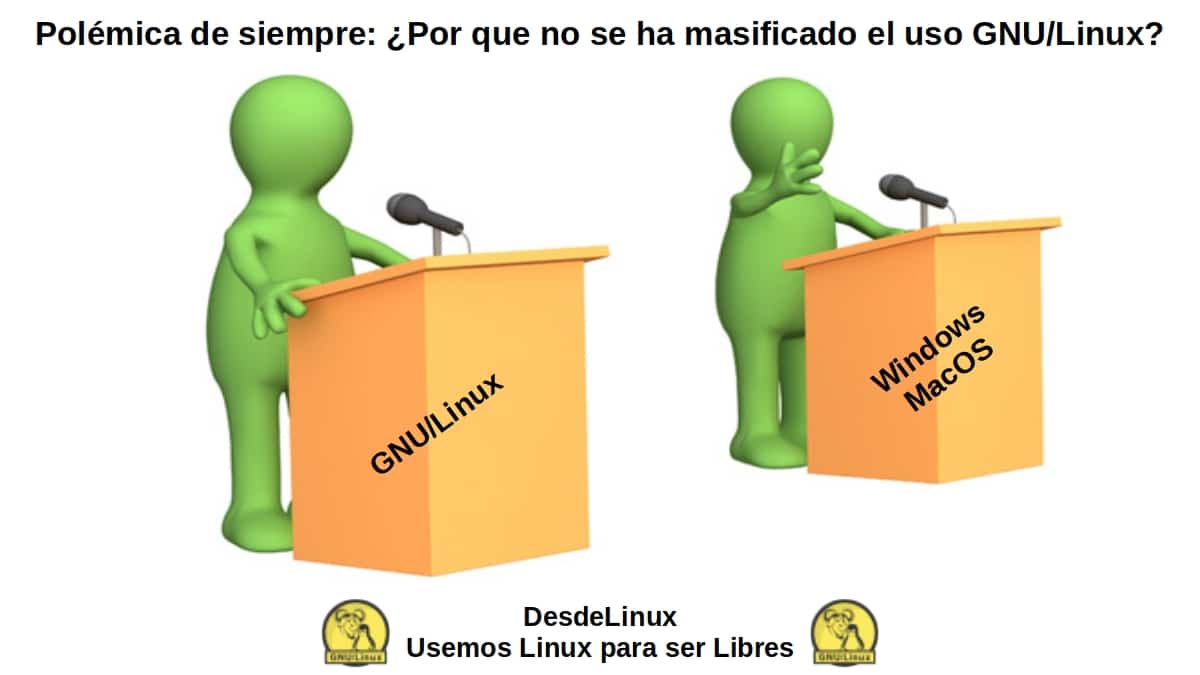
Controversy: GNU/Linux, when will it be the King of the Desktop?
Current points considered in the controversy
In the following we will briefly mention Top 10 of points than in Community of users of free and open technologies, we consider that today they are part of the problem and the solution to achieve this goal:
Compatibility with recent hardware
At this point, more progress should be made in the development and improvement of drivers and firmware created freely and openly by the Community. But above all, in drivers and firmware produced by device and equipment manufacturers, freely and openly.
High level and quality apps to work, study and play
Much progress has been made on this point in the last 10 years, but there is still a long way to go and many things to achieve. Specifically, for example, that large proprietary software companies produce equivalent and native solutions for GNU/Linux.
Free and open ecosystem, but profitable and economically sustainable
Here it is considered that much remains to be done, since every day there are more users, more developers, more community, more applications and systems, but the level of contributions or investment of economic resources by users and the community towards developers independent or in teams, is still very low.
Better user experience
At this point much has been accomplished, and one can almost say it has been surpassed. Many aesthetic and functional innovations have been achieved in the Distributions, both in the Desktop Environments, such as the Window Managers, as well as the applications of general and frequent use. It has gained a lot of stability and usability, and in beauty of the GUIs.
best marketing campaign
At this point much remains to be done, since more and better publicity is needed on the Internet by the entire Community to sell the virtues, benefits and advantages of Free Software, Open Source and GNU/Linux.
Default pre-installation on computers
Little progress has been made here, but more and more interesting initiatives are emerging in this regard, both by small and trading companies, as well as by some large companies and manufacturers.
Migration to mobile, the Internet of things and other technologies
This point is considered in favor, in the sense that Linux is better adapted to the cloud, excellent stability and usability in small devices, and better adaptation to alternative or emerging technologies such as the use of ARM chips.
Errors by third parties in favor of Linux
Both Microsoft on Windows and Apple on macOS can continue to make mistakes in their products or ways of marketing them. That is, if these design errors and limitations are not corrected; the serious and frequent failures, vulnerabilities and abuses of telemetry; the costs and ways of licensing; and the high hardware requirements to operate; all this can continue progressively in favor of more users migrating to free and open, like GNU/Linux.
Fewer Distros, More Apps
At this point, many consider that a great variety of Distributions, Desktop Environments, Window Managers have prevailed over the offer of more and better useful and necessary applications.
More productive and less toxic communities
In this penultimate point, it is considered that the Linux Communities should focus more on troubleshooting, operating system installations, and third-party training, than on less relevant issues such as showing graphical interface customizations and fighting with users of proprietary Operating Systems, closed and commercial.
Training from childhood by the education sector
In this penultimate point, variable achievements are considered, depending on many countries and geographic regions. Since, for example, in some countries or continents more than in others, the degree of support from public educational institutions and other government entities is very different.
For example, in Europe very few regions of certain countries implement programs in this sense. Although, Spain is usually a pioneer in this. While, in Latin America, countries as a whole (such as Cuba, Venezuela and Argentina) tend to implement these programs a little more. Achieving this, donating computers with GNU/Linux installed for students of certain stages/levels and motivating migrations from proprietary software to free and open software, in the possible work platforms of their workers.

Summary
In summary, the basis of this eternal controversy It will surely last for a few more years. In other words, there is probably a long way to go before both GNU / Linux specifically, such as Free Software and Open Source generally reach a point of no return. Both in terms of its relevance, importance and degree of usability, as well as in the number of users, both at home and in offices. Giving rise to it becoming undeniably the King of Desks.
We hope that this publication is very useful for the entire «Comunidad de Software Libre, Código Abierto y GNU/Linux». And don't forget to comment on it below, and share it with others on your favorite websites, channels, groups or communities of social networks or messaging systems. Finally, visit our home page at «DesdeLinux» to explore more news, and join our official channel Telegram from DesdeLinux.
It is nothing of what you comment here, I only see a point of what you comment, the publicity, the hardware, man if there is more support the more the better, but it has changed a lot compared to years ago, now practically everything is supported, there is much few hardware issues. The issue is actually another and it is none other than that there are things that are established in this world and nobody moves them. Examples: will an operating system come out that will unseat Android? Not resounding, not impossible, but super difficult. Will an app come out that unseats WhatsApp? Impossible. Will a browser or search engine unseat Chrome and Google's search engine? No, will an app come out that unseats Google maps? Not even a joke and so on. No one will ever unseat Windows, why? Well, because it is established, Mac OS has not been able to run with Windows, which has even had its own computers for many more years, well, much less will Linux be able to. Although it works fine for me as it is. Whatever they say Linux is advancing by leaps and bounds and for me that's what counts. I have been using only Linux on my computers for years, absolutely for everything, work, study, leisure, even playing triple aaa games and many others. This is the only real point where it falters, in which games for Linux are released much later than for Windows, so if you are an inveterate gamer who always wants to play the latest, then there is no. But Linux today the problems are practically nil, I have always used nvidia and I have never had a single driver or support problem. I've been testing debian with nvidia on my pc for 4 years with zero problems and on the laptop with xubuntu with zero problems too, can you have a PC with Windows 4 years with zero problems, doing everything with it? At least every year you will have to format it, because it gets slow, due to a thousand viruses, etc. Linux is perfect, I've been doing for years, the same as I did with Windows, but without a single problem, so I don't need it to be the year of the Linux desktop at all, I need it to continue as it is advancing advancing and advancing, nothing What does the Linux of today have to do with that of 10 years ago, it's an abyss and if we go back 20 years or more I won't even tell you. And Windows in which it has changed from xp to 7 to 10, etc?, practically nothing, well that's it.
Greetings, Established. Thank you for your comment and excellent contribution contained in it, coming from your personal experience with GNU/Linux and the IT field, in general.
I use linux, you use linux, but free will exists, or as morpheus says in the Matrix they are so necessarily dependent on using windowsky that they will defend it to the death, a person told me that he had an idea to do a project an acquaintance said to do it on linux and using free software, these two people argued and the project came to nothing.
I asked the project person why he didn't want to use free software and he said «that was obsolete» , and then I remembered those words that said «when destiny sends it, not even the bravest changes it! , if you were born to be a hammer from heaven, the nails will fall on you»
Greetings, Violet. Thanks for your comment. Certainly, part of the freedom (free) and the openness (open) of the philosophy of our Community, is the duty to understand and accept that not everyone wants or can join us, at the times or times that we would like, or for whatever reasons. Let us expose them.
In my personal case, I have had my computer with Linux and Windows for many years, I use Linux for everything, except for playing games, which I have no other choice but to use windows.
There are games that can't be installed or don't work, like Fortnite from EpicGames, and others from Steam that don't work either, I think because of the anticheat programs they require.
Regards Zakar. Thank you for your comment and provide us with your personal experience regarding the subject.
Hello,
Official support issue. The community supports... That is not worth many people, professionals or companies. They want a company where they can report if their problems are not resolved or they do not meet the SLAs of the contract.
Also even for the support of the community, the first thing to say is that I use this or that distribution…. What is valid for debian is not valid for ubuntu, etc. So Linux as such does not exist at the support level.
One-stop configuration window:
The fact that there are a zillion distributions is infumable when it comes to providing support, be it business or community.
But also if each distribution puts things (name/path of configuration files, configuration tools, etc...) where they want it is insane.
standardization bro!
Linux standard base I try but it seems to go through the roof.
One of the few things that windows has good is the control panel, and now they want to load it with windows 11. A single place to centralize the system configuration. The windows registry is fine for being centralized, although a mess in everything else.
A single place to go if something doesn't work or doesn't work as it should. And where the logs are accessed with a click to see what has happened. (Allow access from the UI but keep the console).
How difficult is it to have a centralized application for the system?
How difficult is it for applications that manage important resources or server services or whatever to add/remove their configuration module when installing/uninstalling?
Greetings, Michael. Thank you for your comment and give us your valuable point of view on the matter raised.
The government blocked netbooks with linux, but I think everyone knows Linux, but unfortunately few use it.
The bad thing is that people use something for the sake of ease, not knowing how a library that weighs 3 MB works, when they could do the same thing with a 20-byte command.
Regards, ArtEze. Thanks for your comment. Yes, some Government PCs with Linux are usually Locked through the BIOS.
I see that the biggest problem with GNU/Linux is for music composition
If there are distributions like Ubuntu Studio/Av Linux etc but the problem remains the same or rather the problems
1.Jackd and Pulse these two fight like cat and dog, they can't take the best of both worlds (at least in the distributions dedicated to it) and unify them in a single audio server and that in the configurations you can make them work together or separately (depending if you are going to compose or not)
2-The interfaces of some programs like Rosegarden give GRIMA, some visually are fine but they lack components like Muse Score/Note edit style sheet music viewer integrated in it (Qtractor/LMMS etc) and not to mention that they lack packages of instruments that sound moderately good for these programs and rehearse with MIDI
Those two points are missing from GNU/Linux at least, and not to mention the lack of a theme creation integration to OpenShot as if it has Imovie, if this were true it would be a great OS for me.
Greetings, Dwmaquero. Thanks for your comment and excellent input from your experience as a GNU/Linux user.