

Amazon's game engine, Lumberyard, was always available for free use, but it never received much support from developers . Faced with this lack of appeal, Amazon has opted to make the game engine an open-source project. They have also changed the engine's name and created an organization to monitor the initiative.
All of this Amazon recently announced through an announcement introducing the O3DE (Open 3D Engine) project, which provides an open source game engine suitable for creating AAA games.
The O3DE engine is a redesigned and improved version of the Lumberyard engine, based on CryEngine technologies licensed by Crytek in 2015, and supports various platforms such as Linux, Windows 10, macOS, iOS, and Android. The code is written in C++ and released under the Apache 2.0 and MIT licenses.
O3DE's differences from Amazon Lumberyard include a new Cmake build system , modular architecture, open utilities, a new prefabricated system, an extensible user interface based on Qt, additional capabilities for working with cloud services, performance optimizations, new networking capabilities, and an improved rendering engine with support for ray tracing, global illumination, anticipation, and deferred rendering.
About Open 3D Engine
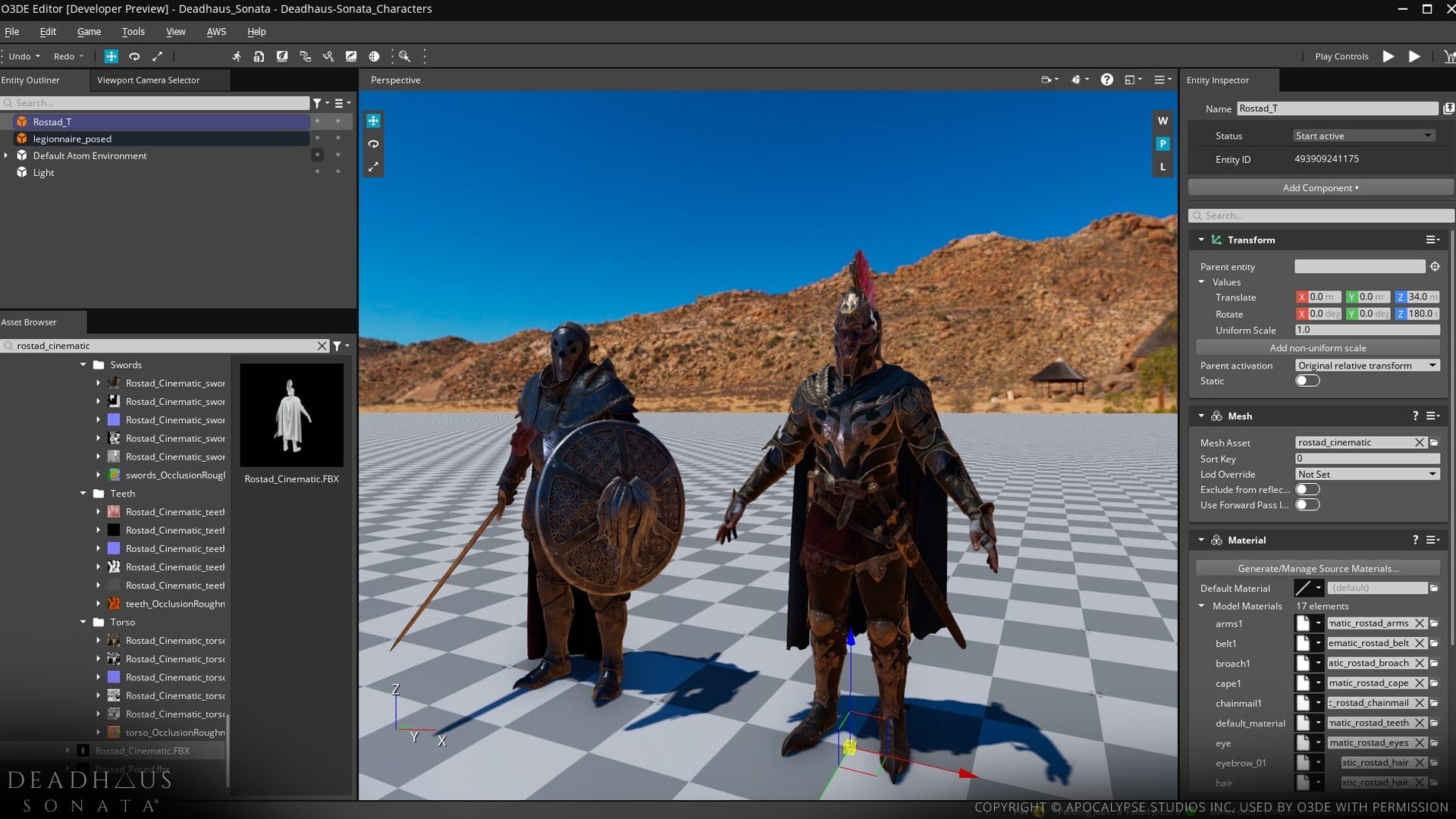
The engine includes an integrated game development environment, a multi-threaded Atom processor, a photorealistic rendering system with support for Vulkan, Metal, and DirectX 12, an extensible 3D model editor, a character animation system (Emotion FX), a pre-built development system (Prefab), a real-time physics simulation engine, and mathematical libraries that utilize SIMD instructions. The visual programming environment (Script Canvas), as well as the Lua and Python languages, can be used to define game logic.
We listen to game and simulation developers who want more options that enable collaboration, customization, and creative control in their production processes. Building 3D tools from scratch can be cost prohibitive, take years to develop, and require significant resources to maintain. These developers end up choosing to spend critical money reinventing the wheel or using proprietary solutions that can be difficult to customize.
It supports NVIDIA PhysX, NVIDIA Cloth, NVIDIA Blast, and AMD TressFX for physics simulation, and also features a built-in network subsystem with support for traffic compression and encryption, network problem simulation, data replication, and stream synchronization. It supports a universal mesh format for game assets, automated asset generation in Python, and asynchronous asset loading.
In total, more than 30 modules are offered, supplied as independent libraries, suitable for replacement, integration into third-party projects, and separate use. For example, thanks to modularity, developers can replace the graphics rendering, sound system, language support, network stack, physics engine, and any other component.
We built a powerful component entity system and a popular visual Script Canvas scripting engine. We also acquired the animation editor Emotion FX, created a modular Gems system, and implemented many Twitch and AWS integrations. But one thing that never changed was our mission: to make world-class free 3D rendering tools accessible to everyone. Now we go one step further.
The engine is already being used by Amazon, several game and animation studios , and robotics companies. New World is a notable example of a game created using this engine.
Finally, it is also mentioned that to further develop the engine on a neutral platform under the auspices of the Linux Foundation, the Open 3D Foundation was created , whose purpose is to provide a high-quality open 3D engine for the development of modern games and high-precision simulators capable of working in real time and providing cinematic quality.
Source: https://aws.amazon.com