

M.AGRIPPA.LFCOS.TERTIVM.FECIT
Marcus Agrippa, son of Lucius, consul for the third time, (did)
It is true that the boys of Elementary OS They like minimalism, but it is clear that they are also very fond of using names that are bombastic or show power. Not for something they called Jupiter to your first OS; the king of the gods Olympus and the largest planet in our solar system. Pantheon means "Temple of all gods" and the building is "Angelic and non-human design" according to the words of the same Miguel Angel. So or more pretentious the name?
However, etymologies and historical references aside, how much "Angelic and not human" is Files of Pantheon that the boys of Elementary? Files is actually a new version of Marlin, whose code was improved, and the end of the developers of Elementary is to use it as your new file explorer GUI call Pantheon. One of the first things you notice about this improvement is that its formal design is much better than the current one. Nautilus de GNOME.
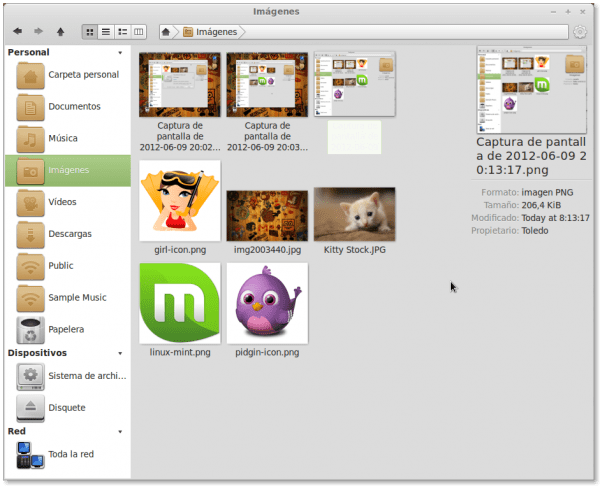
At first glance, we notice a strong resemblance to the Finder, MacOSX, and despite that tendency to "copy" the aesthetics of OS de Apple Lossless Audio CODEC (ALAC), has been one of the most criticized points in the development of Elementary, the development of Pantheon, at least visually, it goes down that path.
Files feels more intuitive and much easier to use than Nautilus because, in accordance with the Fitts Law, has something that the native file explorer of GNOME no: a proper ergonomic design.
In any of the design disciplines -architectural, graphic, industrial, packaging, urban, etc..- the maxim is always that "Form always follows function", And in Files (Fig. No. 1) we find that it is affectively so. All navigation operations input -which are the ones that run the most- are concentrated to the left while in Nautilus (Fig. No. 2) form a large inverted "L":

Fig. No. 1

This that seems so simple is very useful since it avoids the dispersion of attention when browsing our file explorer and we have shorter cursor paths, something that our wrist -what is the one that moves the mouse- thanks.
Another advantage is the hierarchical single-window navigation that allows you to explore the content of a folder and / or subfolders without having to open them to see their content:
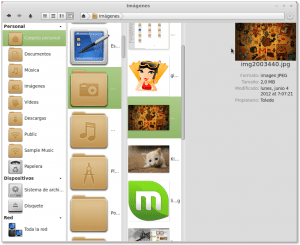

However, not everything is honey on flakes, Files still inherits some of the shortcomings of Marlin, such as the fact of not having an integrated document search engine and a menu that, although it offers other functionalities, is still limited compared to that of Nautilus. The latter may be due to the fact that it is not yet designed to be fully integrated into GNOME or that possibly the guys from Elementary they plan to integrate those functions through extensions.
Even with all this it seems to me a great proposal -at least in terms of ergonomics- which obviously still needs to mature and when it does it will undoubtedly surpass the file explorer of GNOME.
For those who want to try it, they can install it very easily:
sudo apt-add-repository ppa: nemequ / sqlheavy
sudo apt-add-repository ppa: elementary-os / daily
sudo apt-get update
sudo apt-get install pantheon-files
You can also compile the code on the official page: https://launchpad.net/pantheon-files
I liked Marlin, Files I haven't tried it yet.
For now Dolphin (KDE SC 4.8.4) despite having made an appearance on the scene somewhat less than indecent x'D is a «bocato di cardinale»: very light, extremely flexible and moldable to the use and taste of each user and as if it were very powerful, with many options that make it the most complete file manager of the moment.
Very nice theme !! 🙂
It seems nice !!
Actually, I missed Nautilus-elementary a bit. After reading your article, I just installed what would be like his grandson, Pantheon files, and the truth is that it has an excellent navigation bar.
The only major drawback, as you mention yourself, is the lack of a built-in file browser.
I like the functionality of column navigation, but it doesn't show me a "preview" of the images (or other files), as seen in your captures; Is any extension needed or what could it be owed?
Greetings and thanks for the contribution.
Hello Thirteen:
No extension is needed to use this functionality, for the preview to work you only have to do two things:


1.-Activate the "Context Pane" o «Context Panel».
This can be done in two ways:
a.-If you have activated the mode "Menubar":
b.-In "Menubar" mode deactivated, -how i use it- you "click" with the right button of the mouse in a free area where the navigation and visualization icons are, a mini-menu appears and you activate that functionality.
Note: Give a «click» on the images to see them larger.
2.-For space reasons, Files does not show a preview if the window is very small, you have to scale it to a certain size so that the "Context Pane" is visible.
Greetings and I hope I have been useful.
Thanks Tina. It was indeed the "Context pane" and its dimension. Although it had it activated, the area it had (at the bottom of the window) was too small and it was just a matter of giving it more space.
Greetings.
I really like it was using it in ubuntu as the default file browser.
Something also very interesting is that the elementary developers have released their own mutter-based window manager apparently called gala.
What if, no idea when they are going to release the new version of elemntary OS. I don't think it's soon as pantheon shell and gala are not quite stable.
A distro is coming that promises
SolusOS
How are you ??
http://solusos.com/
when you can make a post about this
To leave Files to my liking (seeing the screenshots) I would need to change the location of some elements. Is that possible?
If there is something I like about Dolphin, it is how customizable it is (at all levels). Nepomuk just needs to improve a little for the result to be brilliant. And as I wish windóusico, I would like to have icons type "live folder" (as in Windows) :-P.
That it looks good, it looks good, the thing is that it lacks file search engines, as you said, and I live swimming between libs and files with complex names, imagine what it hurts to look for them by eye xD
It looks nice but I agree with nano the search engine is something essential that should not be missing in a window manager until guindows 7 has (Although it was copied from GNU / LINUX) but it has it.
XD
hi, i'm thinking of writing a tutorial + prints of the elementary desktop, but i don't know how to enlist it. Who do I have to send it to so they can publish it? Cheers
Contact us via Email and we will advise you… anyway my official email is nano[at]desdelinux[.] com
can be installed on fedora
As far as I know no, or not in a simple way.
Great post friend 😉
Thank you dear friend.
By the way, I want to take the opportunity to expand my presentation a little more. The point is that while it's true Files It does not have an integrated search engine, it seems to me that it is not a great lack since there are other methods to search for files:


Note: Click on each image to display it in natural size
Ufff I hope that by the end of the world we already have Elementary OS Luna with us ... and hopefully so much waiting is worth it but I will have to stay in windows because at the moment Ubuntu still does not convince me and Xubuntu has too many bugs for me.
I've been testing and sometimes reporting pantheon-files errors for about a month, and it's almost the same as marlin for now, what I can say is that the elementary developers will put their more characteristic elementary style in the app in the future , that's why they have forked marlin.
The bad thing is that this wait for elementary os luna 2.0 has become an infinite cycle, every time there are more projects on launchpad with the elementary seal all or most of them in betas or alphas, seeing more projects the launch is delayed more.
In these times it is difficult to stay in minimalism
With the name they have stood out
very nice but it would be that the tutorials were for fedora or RPM packages too, not all of us who use GNU / Linux use ubuntu, Thanks.
Hello and welcome.
Excuse me but I don't understand your question ... well, actually I don't know if it's a question or comment. Could you please be specific? Thanks a thousand in advance. 🙂
Great Tina. I really liked the explanation of the inverted L from Nautilus. I do not understand how they still do not realize that the Back / Forward arrows are very uncomfortable in the place they now occupy.
Thanks a thousand friend.
I'm not really sure about it, but I think that's basically because they don't have a proper design studio. One of the great problems of free software development is that the voice that weighs the most is that of computer scientists and not so much that of those of us who are dedicated to design. A clear example is GIMP 2.8… That famous mono-window is a real disaster as a practical design proposal.
Is it really so disastrous GIMP 2.8? It would be very interesting to see your point of view with this topic 😀
LOL! Oh yes it is! In fact, if you look at the "drafts" that's what I'm ... 🙂
I thought I was the only one who thought that, it was to try the single window mode and go back to the xd panel mode
Oh! If this is how you say about GIMP2.8's mono-window, then is Photoshop's design just as disastrous? Or does it vary on something that makes it better for graphic design (Photoshop)?
ps: I look forward to articles on gimp 😛 and thanks in advance 😀
To very hard users of GNU / Linux you tend to itch when someone says, or only suggests, that Photoshop is in many ways superior to GIM. And not only in the ergonomic aspect but also in many other functionalities.
The mono-window design of GIMP is disastrous precisely because they wanted to do it the same as Photoshop and the truth is that -as we will see in the article that I will write- it was not necessary to do that.
Of course, that's why Adobe products stopped being multi-window for a long time, because obviously they don't know what they do ...
Oh shit, wait a minute ... but without the undisputed owners of the industry since the computer began to be used to design and layout 😀
Maybe they are wrong, you should warn them ...
Martín: About Adobe if they know what they are doing, what they obviously do not know what they are doing are GIMP
It seems to me that before trying irony you should read well what I wrote, understand and then -if you feel like it- opine. 🙂
So your criticism of the unified window of Gimp that follows the path marked by Adobe with Photoshop does not make sense ... but your criticism makes less sense when this new feature that is the unified window is optional and not mandatory: - \
The truth is that free criticism of the work of a very small group of devs - at this moment there are very few who are actively collaborating with the project - and that they load the development on the shoulder of such an application, when the changes that are criticized are characteristic New ones that are left to the user's discretion to activate, it is totally pointless.
In addition, I use Gimp almost daily to work and the truth is that I appreciate that they incorporated the unique window.
Greetings.
The fact that you do not like it, in particular, my opinion does not mean that what I affirm does not make sense, or tell me on what fundamentals of industrial and ergonomic design do you base yourself to say that I am not right?
GIMP try to follow the path marked by Photoshop… But this time he did it wrong. And let me clarify that the fact is an optional feature and not FORCED o FORCED-the word «mandatory» (from the English “Mandatory = Obligatorio”) does not exist in Spanish- somewhat saves your mistake because, at the very least, the floating paddle mode is much better than your "innovation".
WITHOUT SENSE -you can afford to write "pointless" and mix words in Spanish and English when your spelling and writing in Spanish is minimal acceptable- It is a criticism like yours, for example, that starts from the total ignorance of the arguments that I have to affirm that the mono-window of GIMP it is a gross error. When I finish my topic and publish it, then you will be able to read what I base myself on to make such a statement and if you have arguments based on design and ergonomics to refute my thesis… welcome!
Well, nothing, we can only wait for the article to better understand all this.
Since to say that it is DISASTERY that GIMP released the mono-window style and PhotoShop having the same style for a long time, it is something hmmm ... good? ergonomic? Usable? ... well it leaves me very confused xD and with more desire to read your article to find out better.
regards
A question ? Does Anybody Know When Elementary OS Luna 0.2 Is Released
I just installed it on Ubuntu and it seems to me as stripped down as the poor nautilus, I clarify that it is not the version that appears in the article.
Friends I installed tweak-tool-gnome instead of elementary's own tweak tool, now when I start my elementary it lags and does not load the default manager, as I could recover my previous window manager and make it reload by default.
Thank you, I hope you can help me, thank you