
Sono uno di quelli che ama usare il terminale. Penso che tutti gli utenti di GNU / Linux A un certo punto non possono più farne a meno, perché quel pezzo di finestra pieno di lettere rende la vita molto più facile, giusto?
Ma possiamo farlo sembrare un po 'più carino di quello predefinito. Un esempio di questo può essere visto (e scaricato) da aspetto da gnomo. Il consiglio che ti mostrerò di seguito è di lasciare il nostro terminale con il seguente aspetto:
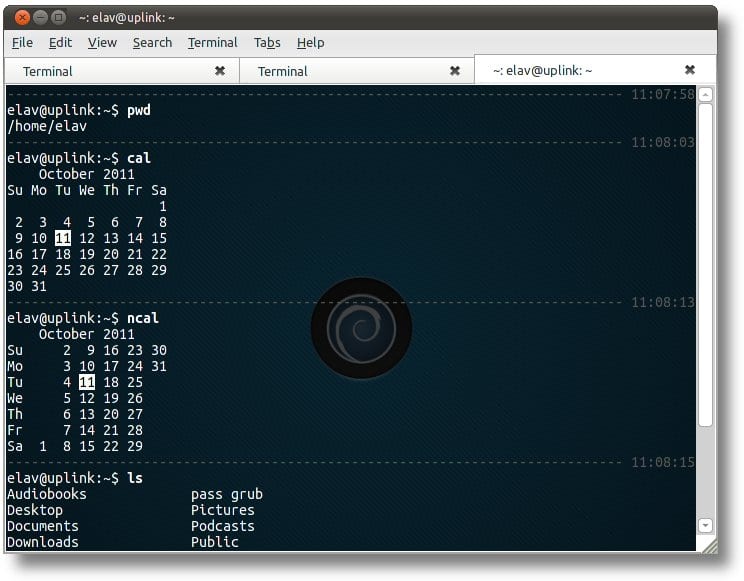
Come puoi vedere, il file comando da eseguire e viene inserito tra ogni ordine una cronologia con l'ora di sistema.
Come lo faccio?
Apriamo un editor di testo (esempio gedit) e lo mettiamo dentro:
# Fill with minuses

# (this is recalculated every time the prompt is shown in function prompt_command):
fill="--- "

reset_style='\[\033[00m\]'

status_style=$reset_style'\[\033[0;90m\]' # gray color; use 0;37m for lighter color

prompt_style=$reset_style

command_style=$reset_style'\[\033[1;29m\]' # bold black

# Prompt variable:

PS1="$status_style"'$fill \t\n'"$prompt_style"'${debian_chroot:+($debian_chroot)}\u@\h:\w\$'"$command_style "

# Reset color for command output

# (this one is invoked every time before a command is executed):

trap 'echo -ne "\e[0m"' DEBUG

function prompt_command {

# create a $fill of all screen width minus the time string and a space:

let fillsize=${COLUMNS}-9

fill=""

while [ "$fillsize" -gt "0" ]
do

fill="-${fill}" # fill with underscores to work on

let fillsize=${fillsize}-1

done

# If this is an xterm set the title to user@host:dir

case "$TERM" in

xterm*|rxvt*)

bname=`basename "${PWD/$HOME/~}"`

echo -ne "\033]0;${bname}: ${USER}@${HOSTNAME}: ${PWD/$HOME/~}\007"

;;

*)

;;

esac

}

PROMPT_COMMAND=prompt_command
Lo teniamo dentro il nostro / Home con il nome .bash_ps2 per esempio. Quindi apriamo il nostro .bashrc e aggiungiamo:
if [ -f "$HOME/.bash_ps2" ]; then

. "$HOME/.bash_ps2"

fi
Apriamo un terminale e possiamo vedere le modifiche 😀
Visto in: Umani.
Grazie per il blog prima di tutto e una domanda, c'è qualche possibilità di personalizzare xterm o lxterminal oltre al colore del testo e dello sfondo? (Sono i terminali che uso di più).
Gracias¡¡
GENIALLLLLLLLLLLLLL 🙂
L'ho provato una settimana fa quando ho letto questo argomento in un altro blog, ma a causa di un problema con le virgolette in quello che doveva essere aggiunto al .bashrc Non potrei usarlo. Ora ha funzionato correttamente prima per me.
Grazie.
Un piacere sapere che ha fatto proprio quello che volevi 😉
saluti
:] eccellente se fa quello che penso di immaginare ... weeee, lo installo questo fine settimana 😀
In effetti l'ho migliorato hehe ... ho messo più rossori e sembra molto meglio, farò un post pubblicando i miei miglioramenti e modifiche 😉
Modificato: Invece di metterlo dentro .bash_ps2 metti questo un altro: http://paste.desdelinux.net/paste/6
Ricevo un errore sulle righe 13 e 34.
Siamo già 2 😀
Cazzo, un altro programmatore del lato oscuro ...
Lascio qui il codice, non so perché dà loro un errore ... o_0U funziona bene per me:
# Fill with minuses# (this is recalculated every time the prompt is shown in function prompt_command):
fill="--- "reset_style='\[\033[00m\]'
status_style=$reset_style'\[\033[0;90m\]' # gray color; use 0;37m for lighter color
prompt_style=$reset_style
command_style=$reset_style'\[\033[1;29m\]' # bold black
# Prompt variable:
PS1="$status_style"'$fill \t\n'"$prompt_style"'${debian_chroot:+($debian_chroot)}\[\033[01;32m\]\u@\h\[\033[00m\]:\[\033[01;34m\]\w\[\033[00m$
# Reset color for command output
# (this one is invoked every time before a command is executed):
trap 'echo -ne "\e[0m"' DEBUG
function prompt_command {
# create a $fill of all screen width minus the time string and a space:
let fillsize=${COLUMNS}-9
fill=""
while [ "$fillsize" -gt "0" ]
do
fill="-${fill}" # fill with underscores to work on
let fillsize=${fillsize}-1
done
# If this is an xterm set the title to user@host:dir
case "$TERM" in
xterm*|rxvt*)
bname=`basename "${PWD/$HOME/~}"`
echo -ne "\033]0;${bname}: ${USER}@${HOSTNAME}: ${PWD/$HOME/~}\007"
;;
*)
;;
esac
}
PROMPT_COMMAND=prompt_command
Molto bello questo, l'ho appena provato e funziona al 100% con Ubuntu 11.10
Saluto!!
Bene, ricevo un errore anche alle righe 13 e 34
riga 13: EOF imprevisto durante la ricerca di una corrispondenza ``
riga 34: errore sintattico: la fine del file non era prevista
Uso linux mint 11 lxde per quello che vale.
Saluti!
Funziona al 100% con l'utente normale, ma nel momento in cui diventi superutente smette di funzionare, non fa nulla. Immagino sia facile, ma non so come fare molto, qualche soluzione?
Cosa metti nel tuo file .bashrc, devi anche inserirlo /root/.bashrc
Fai il test e dicci come stai 🙂
Saluti 😀
Funziona perfettamente, non so come non l'ho provato prima di chiedere. Grazie
Nah non preoccuparti 🙂
Ehi amico, se mi vuoi aiutare per favore l'ho provato ma il cerchio non compare ed è ancora nero, io uso fedora19, la timeline se compare ... ancora grazie mille per il tuo contributo
funziona allo stesso modo in Debian ???