
나는 터미널 사용을 좋아하는 사람들 중 하나입니다. 나는 모든 사용자가 GNU / 리눅스 한때 그들은 그것 없이는 살 수 없습니다. 왜냐하면 글자로 가득 찬 그 창은 우리에게 삶을 훨씬 쉽게 만들어주기 때문입니다.
하지만 기본값보다 조금 더 예쁘게 만들 수 있습니다. 이에 대한 예는 다음에서 보거나 다운로드 할 수 있습니다. 그놈 모양. 다음에 보여 드릴 팁은 다음과 같은 모습으로 터미널을 떠나는 것입니다.
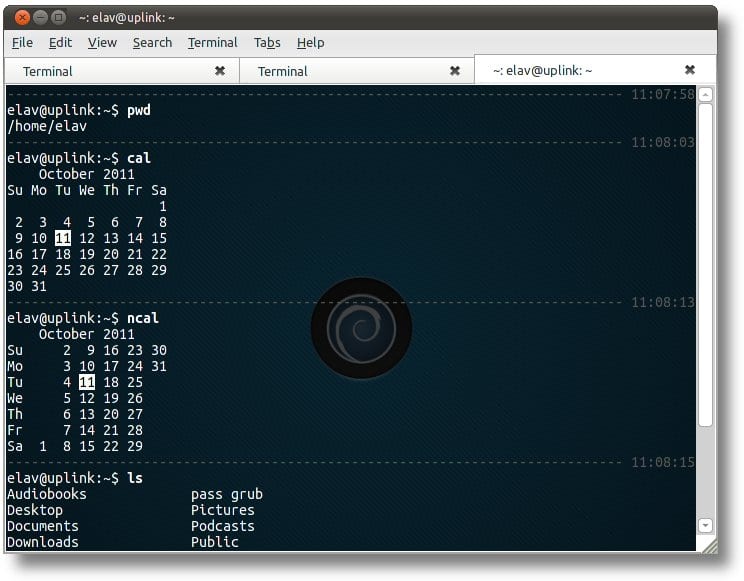
보시다시피 실행할 명령 그리고 각 주문 사이에 놓입니다 타임 라인 시스템 시간과 함께.
어떻게합니까?
텍스트 편집기를 엽니 다. (예 Gedit) 그리고 우리는 그것을 안에 넣습니다.
# Fill with minuses

# (this is recalculated every time the prompt is shown in function prompt_command):
fill="--- "

reset_style='\[\033[00m\]'

status_style=$reset_style'\[\033[0;90m\]' # gray color; use 0;37m for lighter color

prompt_style=$reset_style

command_style=$reset_style'\[\033[1;29m\]' # bold black

# Prompt variable:

PS1="$status_style"'$fill \t\n'"$prompt_style"'${debian_chroot:+($debian_chroot)}\u@\h:\w\$'"$command_style "

# Reset color for command output

# (this one is invoked every time before a command is executed):

trap 'echo -ne "\e[0m"' DEBUG

function prompt_command {

# create a $fill of all screen width minus the time string and a space:

let fillsize=${COLUMNS}-9

fill=""

while [ "$fillsize" -gt "0" ]
do

fill="-${fill}" # fill with underscores to work on

let fillsize=${fillsize}-1

done

# If this is an xterm set the title to user@host:dir

case "$TERM" in

xterm*|rxvt*)

bname=`basename "${PWD/$HOME/~}"`

echo -ne "\033]0;${bname}: ${USER}@${HOSTNAME}: ${PWD/$HOME/~}\007"

;;

*)

;;

esac

}

PROMPT_COMMAND=prompt_command
우리는 그것을 우리 안에 보관합니다. 홈 / 이름과 함께 .bash_ps2 예를 들면. 그런 다음 우리는 .bashrc 다음을 추가합니다.
if [ -f "$HOME/.bash_ps2" ]; then

. "$HOME/.bash_ps2"

fi
터미널을 열면 변화를 볼 수 있습니다 😀
본 : 인간.
먼저 블로그에 감사드립니다. 질문이 있습니다. 텍스트와 배경색을 넘어서 xterm 또는 lxterminal을 사용자 정의 할 수 있습니까? (제가 가장 많이 사용하는 터미널입니다).
고맙습니다
일반 LLLLLLLLLLLLLL ????
나는 일주일 전에 다른 블로그에서이 주제를 읽을 때 그것을 시도했지만, 인용문에 문제가있어서 .bashrc 나는 그것을 사용할 수 없습니다. 이제 먼저 제대로 작동했습니다.
그라시아.
그것이 당신이 원하는 것을했는지 알게되어 기쁩니다 😉
안부
:] 내 생각대로하면 훌륭합니다 ... weeee, 이번 주말에 설치합니다 😀
사실 나는 그것을 개선했다 hehe ... 나는 더 많은 홍당무를 넣었고 훨씬 좋아 보인다. 내 개선과 수정을 게시하는 포스트를 만들 것이다 😉
수정 됨: 넣는 대신 .bash_ps2 이것을 다른 넣어 : http://paste.desdelinux.net/paste/6
13 행과 34 행에 오류가 발생합니다.
우리는 이미 2 😀
젠장, 또 다른 다크 사이드 프로그래머 ...
여기에 코드를 남겨두고 왜 오류가 발생하는지 모르겠습니다 ... o_0U가 잘 작동합니다.
# Fill with minuses# (this is recalculated every time the prompt is shown in function prompt_command):
fill="--- "reset_style='\[\033[00m\]'
status_style=$reset_style'\[\033[0;90m\]' # gray color; use 0;37m for lighter color
prompt_style=$reset_style
command_style=$reset_style'\[\033[1;29m\]' # bold black
# Prompt variable:
PS1="$status_style"'$fill \t\n'"$prompt_style"'${debian_chroot:+($debian_chroot)}\[\033[01;32m\]\u@\h\[\033[00m\]:\[\033[01;34m\]\w\[\033[00m$
# Reset color for command output
# (this one is invoked every time before a command is executed):
trap 'echo -ne "\e[0m"' DEBUG
function prompt_command {
# create a $fill of all screen width minus the time string and a space:
let fillsize=${COLUMNS}-9
fill=""
while [ "$fillsize" -gt "0" ]
do
fill="-${fill}" # fill with underscores to work on
let fillsize=${fillsize}-1
done
# If this is an xterm set the title to user@host:dir
case "$TERM" in
xterm*|rxvt*)
bname=`basename "${PWD/$HOME/~}"`
echo -ne "\033]0;${bname}: ${USER}@${HOSTNAME}: ${PWD/$HOME/~}\007"
;;
*)
;;
esac
}
PROMPT_COMMAND=prompt_command
아주 좋아, 방금 테스트했고 100 % 우분투 11.10에서 작동합니다.
인사!!
글쎄요, 13 번과 34 번 줄에도 오류가 있습니다
13 행 : 일치하는``를 검색하는 동안 예기치 않은 EOF
34 행 : 구문 오류 : 파일의 끝이 예상되지 않았습니다.
나는 가치있는 것을 위해 리눅스 민트 11 lxde를 사용합니다.
안녕하십니까!
일반 사용자에게는 100 % 작동하지만 수퍼 유저가되는 순간 작동을 멈 춥니 다. 쉬운 것 같지만 많은 방법을 모르겠습니다. 어떤 해결책이 있습니까?
당신이 당신의 .bashrc, 당신은 또한 넣어야합니다 /루트/.bashrc
시험을보고 어떻게 지내십니까?
인사 😀
완벽하게 작동합니다. 질문하기 전에 어떻게 시도하지 않았는지 모르겠습니다. 감사합니다
아니 걱정하지 마세요 🙂
친구여, 도와 주시면 제발 시도해 봤는데 원이 나타나지 않고 여전히 검은 색으로 표시됩니다. 저는 fedora19를 사용합니다. 타임 라인이 나타나면… 어쨌든, 여러분의 기여에 대단히 감사합니다
데비안에서도 똑같이 작동합니까?