
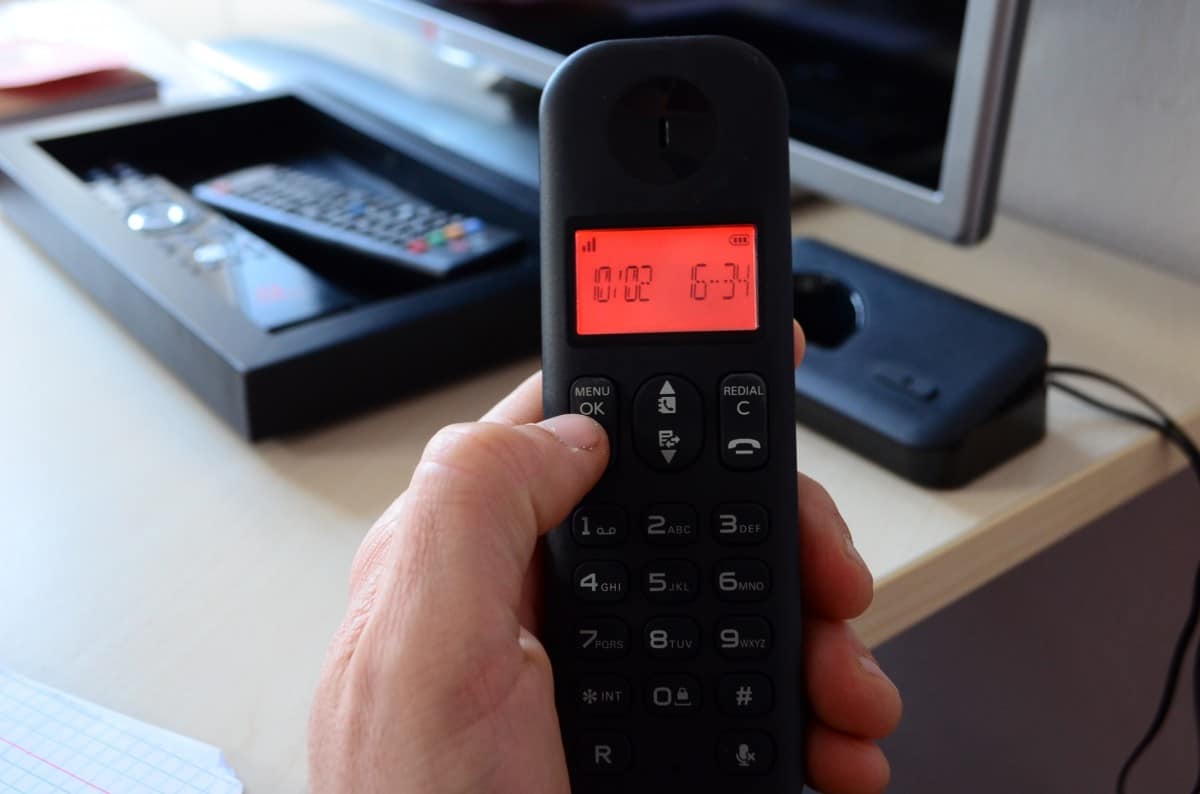
Whether the SARS-CoV-2 pandemic has prompted you to work remotely from home, or you simply want to feel safer in your home or office, you should know that cordless phones and VoIP are a target for many cybercriminals looking to attack businesses or individuals.
Keep in mind that a cyberattack can cause significant losses for your business, as well as the leakage of sensitive information belonging to your company or clients. Therefore, to prevent your conversations from being monitored, you should follow some practical tips that you can implement yourself.
Introduction
Traditional landlines are still common in many businesses and homes, although they have been gradually replaced by mobile phones and VoIP. Despite their age, they remain one of the most stable and reliable methods of communication for long-distance calls.
However, landline telephony has also evolved considerably in recent decades, from primitive telephones to today's cordless phones. Wireless technology has become cheaper and more sophisticated, eventually replacing the conventional telephone.
The new cordless phone eliminates the limitations of cables , allowing you to move around as needed while making calls, as long as you are within range of the wireless technology used.
Old wired phone lines could be tapped, but this can also be done on modern wireless and VoIP lines. However, it's true that modern cordless phones have evolved from using unprotected, open AM radio waves (which could be intercepted) to encrypted digital communications to protect them from prying ears.
So is the cordless phone safe?
Nothing is 100% secure ; cybercriminals are constantly finding new vulnerabilities and attack methods. Furthermore, depending on the technology your cordless phone uses, intercepting a conversation can be more or less easy.
If your cordless phone does not specify that it has DDS (Digital Spread Spectrum) or DECT (Digital Enhanced Cordless Technology) technology , then it will be transferring in analog technology (even though they are wireless).
If it's an analog phone, you'll be dealing with the most vulnerable cordless phones . While digital phones are somewhat more secure, they're not entirely immune to attacks where third parties could eavesdrop on your conversation. Some penetration testers and cybercriminals have managed to intercept encrypted conversations using DECT, the type used by some current cordless phone manufacturers.
To intercept conversations, attackers would only need specific software and hardware. Furthermore, the software tools are open source and free , so obtaining the necessary components for espionage is quite simple. The required hardware, however, simply involves a PC with a DECT-compatible wireless network card (fortunately, these are neither easy to find nor cheap).
DECT is currently evolving to implement new security measures to the standard, making it more secure. However, not all cordless phones will adopt these measures, so many models could remain vulnerable.

How to protect your phone against wireless attacks
Generally, unless your company handles particularly valuable information , it's not cost-effective to purchase the hardware needed to spy on specific targets. But that shouldn't make you complacent, because once a cybercriminal has the necessary equipment, they can use it against many of their victims.
Another advantage of this type of technology is that intercepting DECT communication data requires the cybercriminal to be close to the premises where the cordless phone is installed. The good news is that their coverage range isn't very large, making it more difficult to intercept the signal.
Nevertheless, some tips you should keep in mind are:
- If you have an analog cordless phone, switch to a more secure DECT. If you are paranoid, better use a corded phone for the most sensitive calls or an encrypted VoIP one.
- In a large office or home, place the phone in the center of the building. This will make it more difficult for the signals to be intercepted. It should never be close to a wall with an adjacent dwelling, or close to the exterior walls of the building.
Specific measures for VoIP phones
VoIP phones use the Internet Protocol (IP) for communication, instead of traditional telephone wiring. Therefore, it's necessary to implement different measures to improve your network security:
- Using a router with VPN to encrypt all network traffic can be a great option for protecting VoIP communications.
- A separate VLAN could be used for telephony from the network you use to browse.
- Invest in cybersecurity companies that can perform security audits on your network to reinforce any weaknesses that may exist.
- Train your employees, because when the system is secure, the best way to get what you want is to go for the weakest link: the user.
Other additional measures
It's not only important to protect equipment, but also to maintain safety measures for your employees and yourself in the office. Therefore, it would be advisable to follow a series of additional measures until a vaccine or effective treatment for Covid-19 is available. These basic measures include:
- Maintain a safety distance of 2 meters between people and avoid crowds.
- Wear approved masks whenever working indoors with more people or outdoors if the safety distance cannot be maintained.
- Hand washing and surface disinfection.
- Use of protective screens, gloves, and other items if necessary.