

With the large size of data files these days, hard drives can fill up quickly . For this reason, it's a good idea to install a tool that allows you to analyze hard drive usage to help you keep track of large files and delete them if necessary.
That's why today we're going to talk about a great tool that will help us analyze our disk on our preferred Linux system.
QDirStat is a program that uses graphical representation to show us what is taking up free space on our disk, including interesting options if we feel like cleaning it up.
We are talking about a software that is heir to the veteran KdirStat, but that unlike this one no longer carries KDE dependencies, only the latest versions of the Qt5 library.
How to install Qdirstat on the different Linux distributions?
This application is available within the repositories of the vast majority of current Linux distributions, so its installation is relatively simple and this tool can be found in your preferred software center.
In the same way, for those who prefer it, they can install this application from the terminal by executing the commands indicated for their Linux distribution that they are using.
If you are a user of Debian, Ubuntu, Linux Mint, Elementary OS or any system derived from these, you can install this tool with the following command:
sudo apt-get install qdirstat
For users of Arch Linux , Manjaro, Antergos, or any Arch Linux-derived system, you can install the software directly from the AUR repositories , but you will need an installation wizard.
The command to install that I share is using yay, just replace it with your AUR assistant that you have in use.
yay -s qdirstat
For users of CentOS, RHEL, Fedora, and derivative systems, the application can be installed using the following command:
sudo yum install qdirstat -y
If you are a user of any version of OpenSUSE, simply install with the following command:
sudo zypper install qdirstat
How to use qdirstat on Linux?
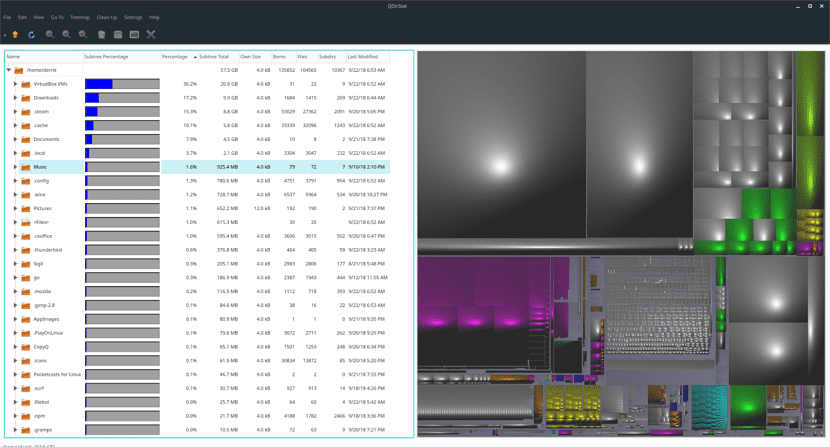
To start searching for files and folders, you must run Qdirstat.
As soon as the program opens, you will see a selection window . The file finder lists all the directories you can access on the system.
Look through the file explorer window and select the area you want to scan . For most users, the ideal folder to choose is "home".
It is possible to scan other hard drives, apart from the one on which your Linux operating system is configured.
To do this, they must click on the left sidebar in the Qdirstat file browser, locate their desired hard drive and access it.
When Qdirstat scans a folder, a "Tree Map" will appear on the left side of the window.
This Treemap is very simple and easy to navigate. On the right side of the screen, you will see a graph with several squares in different colors.
The data graph allows users to see a visual representation of the data in the directory they scanned.
To view a file through the Qdir visual chart, click on any square.
Selecting a square will instantly display the exact location of the data on the treemap to the left.
Alternatively, you can right-click on a data box and click "copy URL" to get its location on your computer.
To delete a file or folder in Qdirstat, look at its Treemap and right-click on a search result and click the "Delete" button.
Selecting "delete" will remove the file from your computer instantly, so there is no going back.