
Material Design is undoubtedly one of the most important novelties in Android Lollipop 5.0. The designers of Google have managed to create a series of elements for the interface of the applications that in particular, I love.
Unfortunately, to fully enjoy Material Design you have to use Android, but thanks to Quantum OS, we can have a Shell for our GNU / Linux with that appearance.
What is Quantum OS?
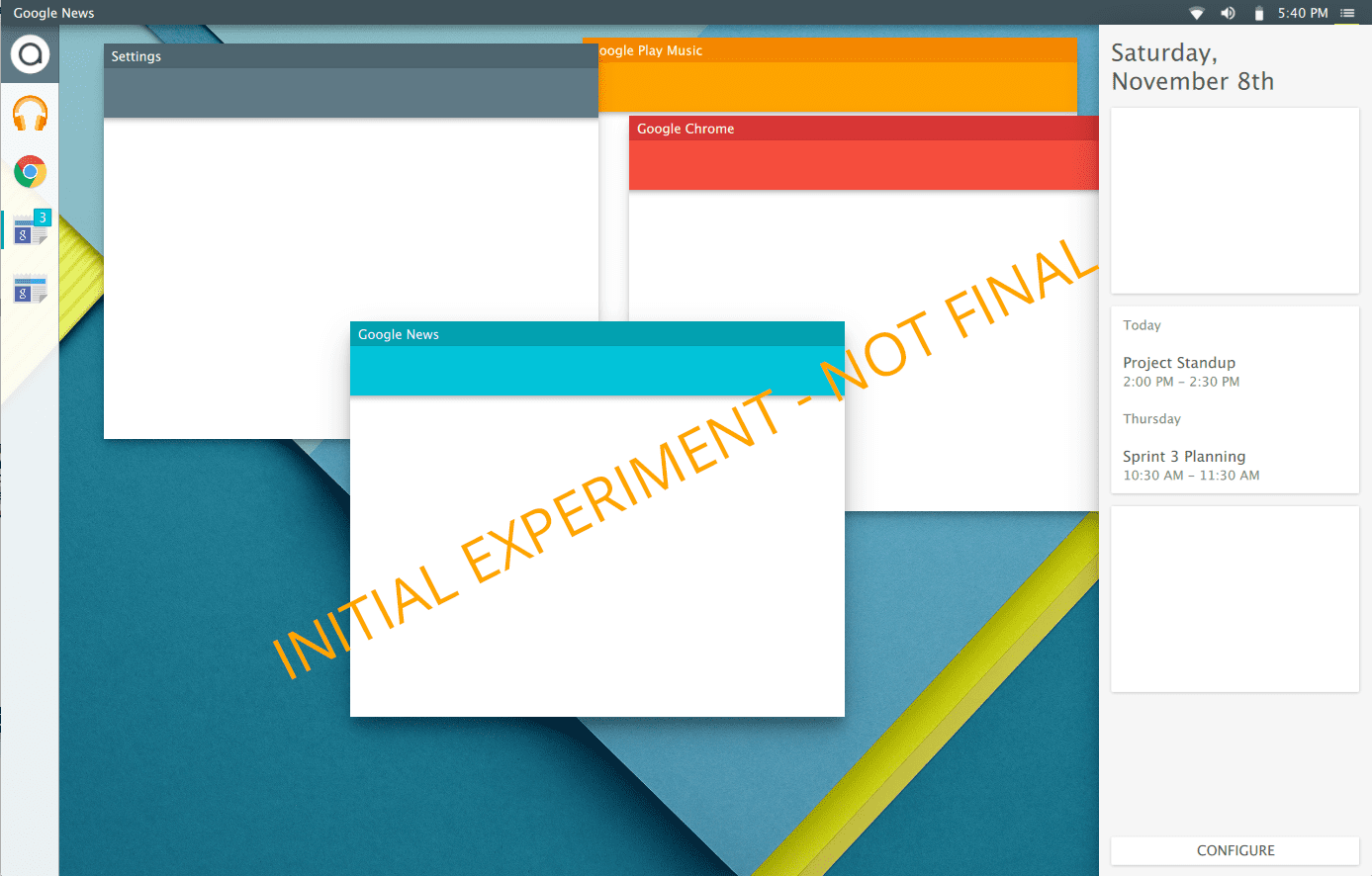
According to its developer, Michael Spencer/@iBeliever, your focus will be on creating a stable and easy-to-use operating system, with a strong emphasis on well thought out design.
Michael intends to develop a Shell desktop (and its applications) using mainly Qt5 y QML, which will allow to build highly polished and dynamic user interfaces.
Michael va a aprovechar inicialmente un sistema operativo existente para construir Quantum OS, lo más probable es que sea Arch o Ubuntu. Arch es una posibilidad fuerte debido a la gestor de empaquetado simple, su sistema base ligero, y el concepto rolling release. Eso si, al parecer quiere hacerlo en una distribución que tenga soporte para Wayland.
This is because the applications will use as a base a set of tools called QML-UI that already has Material Design included. Está escrito desde cero, y no utiliza controles QtQuick, y no es un fork o un tema para el conjunto de herramientas de interfaz de usuario de Ubuntu. Además, se tratará de hacer un tema QT/GTK para aplicaciones ya existentes.
My take on Quantum OS
At the moment everything looks very nice with Quantum OS, and when you have Material Design much more. It is true that there is still not much to see to be able to issue a solid criterion, but if at first (from the image above) it is going to start looking like Unity, we are not going to do it, unless it lets us customize the desktop.
Creating the necessary applications so that Quantum OS becomes a complete Desktop Environment I see it unnecessary, since there are many applications written in QT / QML that can be used, but anyway we should see the proposals that Michael Spencer is going to us bring and as always, alternatives are appreciated.
The project looks good, now we have to see if a single person can carry it out; although I am sure that if it turns out to be interesting in the short term, many others will join in and hopefully so. With this post, I hope to give it some promotion and spread the word.
A DE based on a graphic design concept, which will probably go out of style in 3 or 4 versions of Android / iOS. What a great idea !!
/s
Well, like everything, like Flat, and like everything that is fashion and then passes ... but Material Design is much more than pastel colors and flat design ...
Excellent, we hope it is accessible from any Distribution and that it is available as soon as possible. Besides that of course it is highly Modifiable because that is what in the world of free software we are used to
I can only agree with juanfgs. When I read elav's answer I went to see what the heck was about Material Design and the truth is I never saw so much bullshit together. I read the ENTIRE document, I almost died of hunger and boredom, but I made it. For the brave, here is the link:
http://www.google.com/design/spec/material-design/introduction.html
In the end, if they support it, there are some links to the fonts and icons that I think is the only thing that can be made of value.
I keep my old Android and as soon as I can I put a cooked ROM on it.
What a crab with these people trying to be… modern?
PS: And it is not that it is wrong to have something nice (although I always opt for the functional before) but this time they went too far.
As I said before, Material Design is more than flat design, fonts and blah blah blah .. They are transitions, animations, smart shadows, anyway… Anyway Giskard, for color tastes 😉
Don't get me wrong, I personally love Material Design, but it's just a design fad. Developing a whole stack of applications to make it look beautiful under a fashionable design does not seem very interesting to me.
Although on the other hand it worked a lot for the people of Elementary, PEEERO more than anything because their motivation was more usability than design and they keep actively developing this aspect, it is more than a pretty face, let's say.
@juanfgs: That is precisely the problem, Material Design is not only a change in the design, it goes further. I advise you to see the Google I / O if you have not done it so that you can see.
What's wrong with Unity?
Nothing. But since everyone likes to create their own distro and continue with fragmentation.
Anyway, we'll keep screwed.
It will have nothing wrong for you .. Giskard, but for me it does:
- It won't let me change the position of the panel.
- It won't let me change the position of the dock.
For me two reasons more than enough. That is what is wrong with Unity, which is intended to be used as SI or SI by default.
I use LXDE, although the agent says otherwise, so I don't use Unity. But between one more distro and Unity I prefer Unity. Fragmentation already has me green.
PS: «Green» for that of for color tastes, hehe.
PD2: LXDE lets me do everything. That is cool.
Well, with KDE I don't feel fragmented 😛
It has my full attention, something cute and flat
Where MATE is:…. 🙂
I wish lxqt would look like this: cry
The truth would be good if maybe a good developer like this joined a nice project like lxqt, or xubuntu or elementary or linuxmint, contribute their knowledge and experience in design.
Basically the design is taking it from Google's work, there is not much to contribute in that sense. For my part, I would not want it to join eOS, or any other GTK environment, if it were up to me, everything would be QT.
🙁 but you wouldn't have bindings for as many languages as GTK
It is very attractive in a while I will move to Linux for good and maybe if the project goes well I will try it but for the moment I look directly at eOS
It doesn't make sense to me for various reasons, why fork an operating system just to tweak some visual details? that in the end, just developing a desktop environment is enough.
In addition, these one-person projects I only see an experimental use, I would hardly trust a project as well as the main system.
I love the idea of bringing MaterialDesign to the linux environment, but for it to be successful it has to be one more option to be installed in each one's distro of choice.
just to tweak some visual details?
You are developing a DE, not a theme. If anything, you are creating something from scratch, not forking.
That is precisely why I say that it is making a fork, and I think that not even that, it would only take an operating system already developed, it would install its desktop environment and rename it as quartzOS without more, for that it is not necessary to create another linux distribution, it is developing an environment not an operating system (gnome, kde, lxde, mate, etc ... they are not OS), if not, we fall into more of the same, such as kubuntu, lubuntu, xubuntu, tubuntu, mibuntu ... and so on until a day just by putting a pink wallpaper the pinkbuntu distro comes out.
This topic is one more reason why I love openSUSE, the system is openSUSE, whatever environment you put in it, it doesn't have a thousand names.
Is that the correct answer to the problem is to make a good theme (which is why they were invented) and stop fucking.
As such, wanting to reinvent the wheel on certain issues does not make sense.
I have the same opinion
I can only say, and loud ... Long live the «fragmentation»! . I don't understand what mania people have, in wanting to set themselves up as dictators, and pretending to decide which distros, libraries or desktop environments people have to use. Or what things yes, and what not, developers have to work, as if they paid out of pocket.
In any case, in the very absence of free software the existence of forks is guaranteed, specifically in freedom 3: "The freedom to distribute copies of their modified versions to third parties." And for me it is a very important freedom. If it weren't for the "fragmentation," we wouldn't have MATE, or Cinnamon, or Elementary.
Thanks to "fragmentation" we have everything, everything usable and of good quality. So that anyone can choose what they like best, or is most suitable for their PC and their needs. So stop that idea that everyone with knowledge has to work on what the majority likes, or on what "the community" decides.
The community is not like the word of God, it can also make mistakes and make bad decisions. But because we have freedom, we are always guaranteed alternatives to use or continue using what we really like, or what works better for us.
And that is the most important point. Forks are not made "to fuck" anyone. They are made because there is a certain demand, which can start out very small, but can grow a lot over time. And they do not harm anyone, because the people who develop a fork, would not go to work on any other project of those already established, (in fact, they are usually people who have abandoned those projects due to disagreement with the course they have taken).
Whoever does not want to use them, who does not use them and that's it. But who is the community, or anyone, to decide what is the best, or where do I have to use my effort and knowledge offered freely and freely?
If in the end this QuarzOS consolidates, and ends up being a solid alternative with many users, who does it harm? Who has he screwed? And if it fails, what has been lost? . What's wrong with it? . Is there not a code and a job that someone else in the future can use for their own project?
In my opinion, there is nothing wrong with forks. Thanks to them we have a multitude of options, and fortunately they exist and will always exist in the world of free software. Because the truth is that (if one day they disappeared), it would only be because someone, or some, have finally managed to cut everyone's freedom.
I don't criticize the fragmentation, but doing an OS because you want to implement a new look is like cutting your leg because a nail has grown.
Well, I usually think that people are not stupid enough to develop an entire OS, (with the enormous work that this entails), if the same can be achieved by doing a simple Theme.
So ... Could it be that you can't get the same? . Or perhaps, what is only a beginning, and if things work out, do you have other plans for the future? . As you said before in your comment, Elementary was developed, at first, with a mainly visual and design motivation.
Now it certainly has other added values, and my question is ... why, in this case, could not the same happen? And if this is not the case, qualifying as "stupid" the illusion and the work of these people seems unfair, and a lack of respect.
In free software, in my opinion, there is no useless or wasteful job. Because if a project or idea fails, it never will. A code will always be available there, which may be useful to someone else to develop a future project.
@juanfgs it seems that you did not read the post hehehe. Michael is not going to create a new OS, he is going to use ArchLinux or Ubuntu, what he plans to create is the DE.
I wish it were all usable and of good quality, but it is not like that, there is everything they have out there, each one uses what they obviously like, but with the amount of bugs that Xfce, Mate, Unity, Gnome, etc. have I am sure that people would prefer to use the same software but without bugs, or even one that has more configuration options.
By the way, it seems to me that a fork of a distribution to implement a desktop is a bad idea, and I see that a lot is happening, I do not know if the distros do not give much coverage to new projects or if the developers do not spend in communicating with them.
Well, what you're saying is that most people would like to use Win2, which apparently never has bugs, and it always works like a charm. Or that in free software we should do the same as they do in Win2 or Appel, distribute licenses, and require everyone to work only on one, or two or three projects and to forget to work freely on whatever they want.
The problem is that you start from a false premise, and that is that you must believe, that if more people work on a project, the project improves. The best proof that this is not the case, you have in proprietary software, because that is their way of working, and their software is no better than what we have. And that's without taking into account that they also get paid.
A project is like a bus, someone has to be behind the wheel and decide at a certain moment whether to turn left or right. Because it cannot turn on both sides at the same time, and if it turns out that the driver is wrong, and he takes us the worst way and we hit it, we all hit it, those of us who wanted to go on the right and those who preferred to go on the left
But, if it turns out that those of us who want to go the other way, we have the freedom to get off that bus, and take another that takes us where we want, we will have greatly increased the chances of finally reaching our destination.
The result in the end is obviously an improvement, an improvement that no one would have achieved had there not been the freedom to get off that bus, and to be able to have our own bus when we see fit.
As for the supposed large number of "bugs" of Xfce, Mate, Unity, Gnome etc etc, believe me I have no idea what you mean, because I have used all those desktops in GNU-Linux for quite some time, and except Mate at the beginning, (in the current version it works like a shot and is super stable), I never had any serious or serious problem.
In fact, and from my own experience, I can say that the vast majority of the so-called "bugs" that people blame GNU-Linux are due to poor system administration. To things like adding a gazillion PPAs, without sense or wisdom, to inexperienced hands that "fiddle", and end up "tinkering" where they should not, or to poor hardware support and proprietary services such as Flash or Java.
Look, I would explain why you're wrong, but the truth is that I don't feel like it. Cheers
the URL is changing, now they are called QuantumOS
https://quantum-os.github.io/
See ¬_¬ I already updated the post yesterday .. thanks
At the moment they have already changed the name. Now it is: Quantum OS -> https://plus.google.com/u/0/113262712329378697012/posts
Although the truth, to me so much flat chorradita and other trifles seems a bit silly. It seems that if we don't have a "trendy" desk, we are nothing.
And I tangled with multiple monitors a lot of terminals.
In the end, it's about who has the flattest desk? or cooler? well okay.
I prefer to get the most out of my machines without so much "bullshit" as you say. 😀
+ 1 * 10⁶
looks great
Hopefully it's not vaporware
I think it's good that the development of new distros continues. As for the «Fragmentation» in my opinion #OpenBox leaves lxde speechless.
It reminds me of The duck Launcher that I was using for a while and in the end I returned to Unity (yes, that one, the hated one). I think it's good for them to work on this type of project, I mean, if they have the time and the drive, I'm fine with it. When I get bored I install them, if they don't "give the width" for me, then I uninstall them and continue as if nothing had happened. That if it were my wishes, I would like more for someone to develop an application to be able to develop icon themes with ease, which then there are many and very well achieved on many pages (and free, I say already), but it is a roll to change one to one. But each one of their dreams ... it seems that theirs looks Flat. Regards.
Finally, a very nice desktop, for GNU / Linux distributions, let's hope it continues its development and well, that it comes out for distributions like Ubuntu, to put aside the boring UNITY